
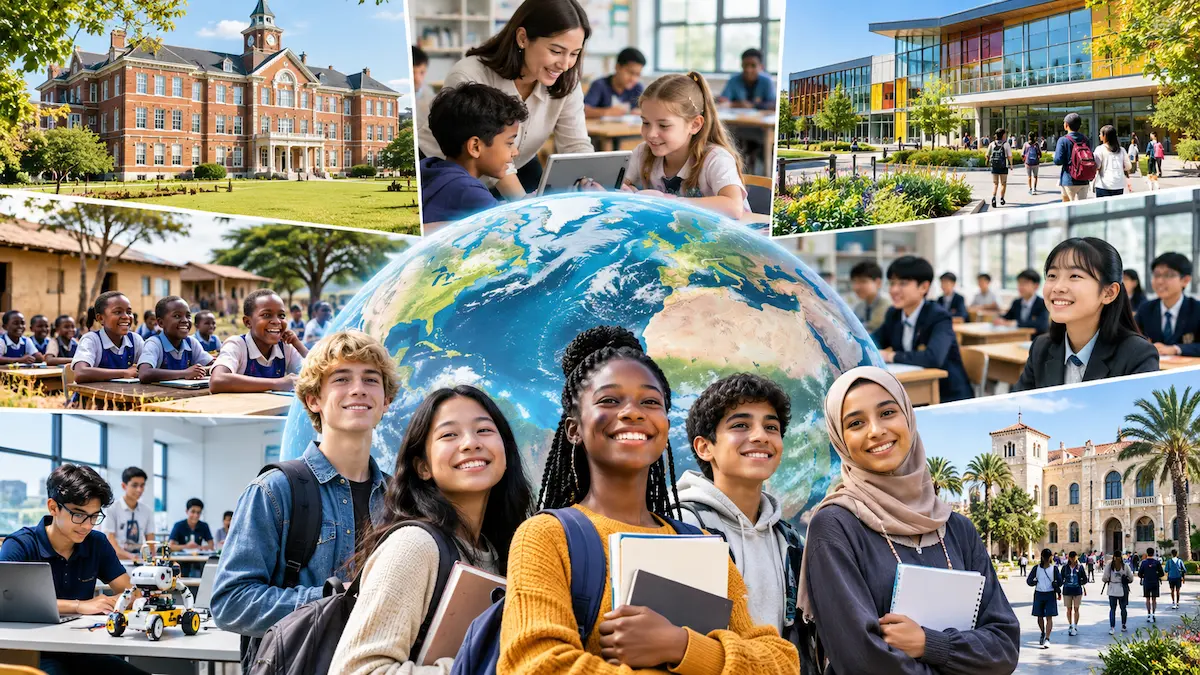
Imagine a child beginning the school day in Japan, another walking into a classroom in Finland, a student preparing for examinations in Morocco, and a teenager joining an online lesson from home in the United States.
They may be studying similar subjects, but their experiences of school can be remarkably different.
Some students wear uniforms. Others choose their own clothes. Some follow national curricula, while others study international programs. Some learn in traditional classrooms with textbooks and whiteboards, while others use tablets, interactive screens, and digital learning platforms.
Yet all these schools share an essential purpose: helping young people develop the knowledge, skills, relationships, and confidence they need for life.
Schools around the world reflect the cultures, histories, economies, and educational priorities of the societies that create them. Understanding these differences helps us ask important questions: What makes a good school? Which education systems are most effective? And what might schooling look like in the future?
In this comprehensive guide, we explore how schools developed, the major types of schools, how education differs across countries, what international research tells us about learning, and how artificial intelligence and new teaching approaches could transform education by 2050.
1. What Is a School? Understanding the Purpose and History of Education
A school is an institution or organized learning environment where students develop knowledge, skills, values, and competencies through structured educational experiences.
But schools do much more than teach reading, writing, mathematics, and science.
They also help children learn how to communicate, collaborate, solve problems, manage disagreements, understand their communities, and participate in society.
How did schools begin?
Education existed long before modern school buildings.
In ancient societies, children learned through families, apprenticeships, religious institutions, and community traditions. Formal teaching also developed in several ancient civilizations.
In Mesopotamia, scribal schools trained learners in writing and recordkeeping. In ancient Egypt, education helped prepare scribes and administrators. Ancient Chinese educational traditions emphasized scholarship and civic responsibilities, while philosophical schools in ancient Greece encouraged discussion and reasoning.
Over centuries, educational institutions evolved into schools, colleges, universities, and specialized training centers.
The development of mass public education accelerated in many countries during the eighteenth, nineteenth, and twentieth centuries. Governments increasingly recognized literacy and education as important for economic development, citizenship, and social participation.
What are the main purposes of schooling today?
Modern schools generally pursue five interconnected goals:
- Academic development: Building literacy, numeracy, scientific understanding, and subject knowledge.
- Social development: Learning cooperation, communication, respect, and responsibility.
- Personal development: Encouraging curiosity, creativity, confidence, and independence.
- Preparation for adulthood: Developing practical, digital, and career-related skills.
- Civic and cultural learning: Understanding society, history, culture, rights, and responsibilities.
An effective school must balance these goals rather than treating examination scores as the only measure of success.
2. Types of Schools Around the World
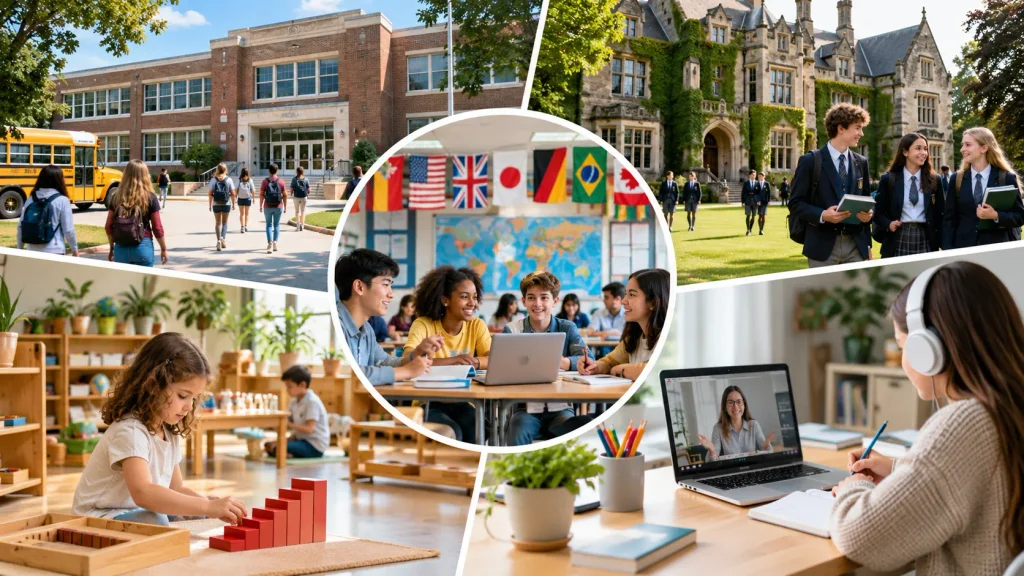
There is no single model of schooling that fits every child, family, or community.
Different schools operate under different ownership structures, educational philosophies, curricula, and teaching methods.
Public schools
Public schools are generally funded or operated by government authorities.
They are designed to provide education to children within a particular country or community, usually without tuition fees for compulsory schooling.
Public schools may follow national or regional curricula, and their resources and quality can vary considerably.
Private schools
Private schools are managed by non-governmental organizations, companies, foundations, or individuals.
They may charge tuition fees and sometimes offer specialized programs, smaller classes, religious education, or particular educational philosophies.
However, private schools are not automatically better than public schools. Educational quality depends on teaching, leadership, resources, student support, and other factors.
International schools
International schools commonly serve families seeking internationally oriented education, including expatriate families and local families interested in foreign-language or international curricula.
They may offer programs such as the International Baccalaureate, Cambridge International, or a curriculum based on another country’s educational system.
An international school may be particularly useful for families who expect to move between countries, although recognition, costs, and language requirements should be checked carefully.
Montessori schools
Montessori education emphasizes purposeful activities, hands-on materials, student independence, and carefully prepared learning environments.
Children are often encouraged to select activities within a structured environment, while teachers observe, guide, and introduce new learning experiences.
Waldorf or Steiner schools
Waldorf education traditionally places significant emphasis on imagination, storytelling, arts, crafts, movement, and age-sensitive learning.
Its approach to technology and academic instruction can differ from mainstream schooling.
Boarding schools
Boarding schools provide residential accommodation as well as education.
Students live at school for part or most of the academic year, following schedules that combine lessons, meals, recreation, and supervised activities.
Religious schools
Religious schools combine academic education with instruction connected to a particular faith or religious tradition.
Their curricula, governance, and funding arrangements vary widely across countries.
Vocational and technical schools
Vocational schools focus on practical and occupational skills alongside, or sometimes instead of, general academic subjects.
Programs may include engineering technology, hospitality, agriculture, design, information technology, and other professional fields.
Online schools
Online schools deliver lessons through digital platforms.
Some provide live classes with teachers, while others combine recorded lessons, assignments, and independent learning.
They can increase flexibility, but students still need appropriate supervision, social opportunities, and academic support.
Homeschooling
Homeschooling is education organized primarily outside conventional schools, usually by parents or guardians, sometimes with support from tutors or online programs.
Its legal requirements vary significantly between countries.
Comparison of major school types
| School type | Main characteristic | Potential advantage | Consideration |
|---|---|---|---|
| Public | Government-funded education | Broad accessibility | Resources vary |
| Private | Independently managed | Specialized options | Tuition costs |
| International | International or foreign curricula | Mobility between countries | Fees and recognition |
| Montessori | Hands-on, child-centered learning | Independence | Implementation quality |
| Waldorf | Arts and holistic development | Creative learning | Curriculum fit |
| Boarding | Residential education | Structured community | Time away from home |
| Religious | Academic and faith-based learning | Alignment with family values | Curriculum and inclusivity |
| Vocational | Career-oriented training | Practical skills | Specialization choices |
| Online | Remote digital instruction | Flexibility | Social interaction and access |
| Homeschooling | Family-organized learning | Individualized scheduling | Legal requirements and support |
The best choice depends on the child’s needs, the quality of the individual institution, family circumstances, and the education options available locally.
3. Education Systems Around the World: Comparing Different Countries
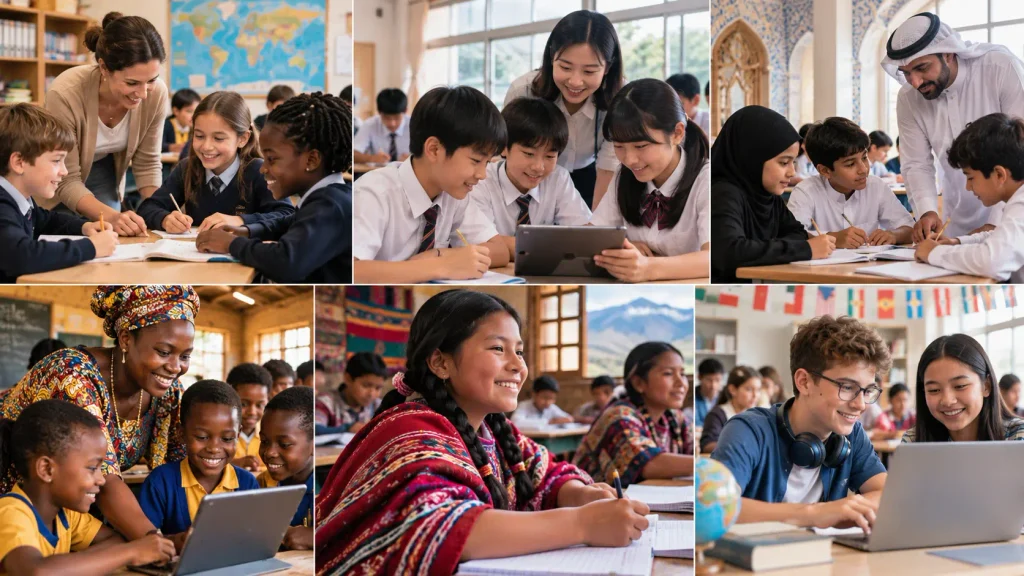
Education systems differ in school starting ages, compulsory education requirements, curricula, examinations, teaching methods, and school organization.
Even within one country, schools may operate differently depending on the region, language, or governing authority.
The following examples describe broad structural features, not every school in each country.
United States: A decentralized education system
The United States does not operate one uniform national school curriculum.
Education is primarily organized through state and local systems.
A common structure includes elementary school, middle school, and high school, often described collectively as K–12 education.
Students may attend public, charter, private, or other legally recognized educational settings.
The American system offers a variety of academic pathways and extracurricular activities, but school experiences and resources can differ considerably between districts.
United Kingdom: Different systems within one country
Education varies across England, Scotland, Wales, and Northern Ireland.
In England, pupils typically progress through primary and secondary education, with GCSE examinations commonly taken around age 16.
Students may then pursue A levels, vocational qualifications, or other approved pathways.
Scotland has its own curriculum and qualification structure.
This makes the United Kingdom an important example of how education systems can differ within the same country.
France: A structured national framework
The French education system is known for its nationally defined educational framework.
Children generally attend école maternelle, followed by école élémentaire, collège, and lycée.
At the end of secondary education, students may pursue different pathways leading to general, technological, or vocational qualifications.
French schools place importance on language, mathematics, science, history, and civic education.
Morocco: A multilingual educational environment
Morocco’s school system includes preschool, six years of primary education, three years of lower secondary education, and three years of upper secondary education.
The country has public schools, private schools, and institutions offering international or foreign curricula.
Arabic and Amazigh are important within Morocco’s educational and linguistic landscape, while French and English also play roles that vary by subject, grade, and institution.
The Moroccan system illustrates the challenges and opportunities of multilingual education.
Finland: Equity and student support
Finland is frequently discussed in international education research because of its emphasis on educational equity, teacher professionalism, and student support.
Children generally begin comprehensive basic education at age seven, although pre-primary education takes place earlier.
Finnish education emphasizes qualified teachers, school support services, and a broad approach to learning.
However, Finland’s system should not be romanticized: it also faces challenges, including changes in learning outcomes.
Japan: Academic learning and school community
Japan’s widely recognized school structure includes six years of elementary school, three years of lower secondary school, and three years of upper secondary school.
School routines often include group responsibilities, extracurricular clubs, and community activities.
Many schools encourage students to participate in maintaining shared learning environments.
Academic expectations can be demanding, particularly during transitions involving entrance examinations.
China: A large and diverse education system
China operates one of the world’s largest education systems.
Compulsory education generally covers nine years, combining primary and junior secondary education.
Students may then enter general upper secondary education or vocational pathways.
The system is associated with significant attention to academic achievement, although educational experiences differ between urban and rural communities and across regions.
Germany: Multiple secondary pathways
Germany’s education system is largely governed by its federal states.
Primary education is followed by different secondary pathways, which vary by state.
Germany is particularly known for its vocational education and apprenticeship traditions, including programs that combine classroom learning with workplace training.
India: Education across languages and regions
India has a large, complex education system involving central and state authorities, public and private schools, and multiple educational boards.
The country’s National Education Policy 2020 introduced a proposed 5+3+3+4 curricular structure, with implementation evolving across jurisdictions.
Language diversity, differences between urban and rural areas, and access to educational resources are major considerations.
Singapore: A focus on academic foundations
Singapore’s education system emphasizes foundational literacy, numeracy, and structured academic development.
Students typically progress through primary and secondary education before entering various post-secondary pathways.
Singapore has performed strongly in international assessments, although academic performance is only one aspect of educational quality.
Quick international school system comparison
| Country | Typical primary starting age | Broad school structure | Distinctive feature |
|---|---|---|---|
| United States | 5–6 | Elementary → Middle → High | State and local control |
| England | 4–5 | Primary → Secondary → Post-16 | GCSE and post-16 pathways |
| France | 6 | Elementary → Collège → Lycée | National curriculum |
| Morocco | 6 | Primary → Lower Secondary → Upper Secondary | Multilingual learning |
| Finland | 7 | Basic Education → Upper Secondary | Equity and support |
| Japan | 6 | 6 + 3 + 3 years | School community routines |
| China | 6–7 | Primary → Junior Secondary → Senior Secondary | Nine-year compulsory education |
| Germany | 6 | Primary → Secondary pathways | Vocational apprenticeships |
| India | About 6 | Primary → Secondary pathways | Multiple boards and languages |
| Singapore | 7 | Primary → Secondary → Post-secondary | Strong academic foundations |
Note: Ages are approximate. School-entry rules, regional structures, and educational reforms may change. Preschool and pre-primary education are not included consistently in the primary-entry column.
The OECD’s Education at a Glance 2025 documents substantial differences in school-entry ages, compulsory education, and the length of primary and secondary schooling.
4. School Levels Explained: From Preschool to University
Although countries use different terminology, many education systems organize learning into several broad stages.
Understanding these stages makes international school comparisons easier.
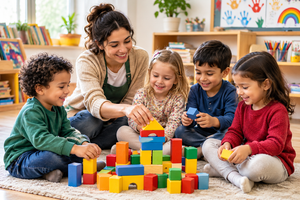
Early Childhood Education
Approximately ages 3–6, depending on the country
Children develop language, social skills, early numeracy, movement, and independence through play and guided activities.
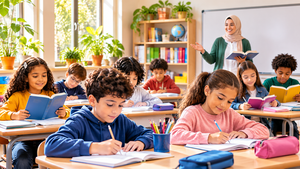
Primary Education
Commonly begins between ages 5 and 7
Students build essential foundations in reading, writing, mathematics, science, and other subjects.
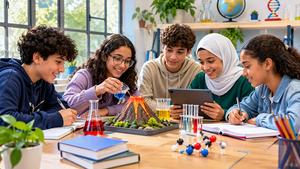
Lower Secondary Education
Often around ages 11–15
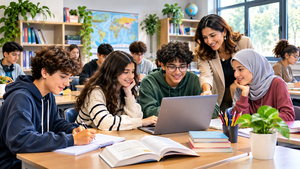
Learning becomes more specialized, with greater academic independence and subject-specific instruction.
Upper Secondary Education
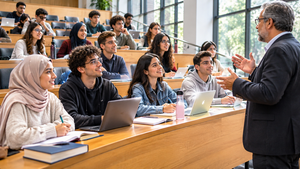
Often around ages 15–18
Students prepare for higher education, vocational training, employment, or other pathways.
Higher Education
Typically follows secondary education
Universities, colleges, and other institutions provide advanced academic and professional education.
Why do school starting ages differ?
Countries choose school-entry ages based on historical traditions, educational research, public policy, and the structure of early childhood education.
Starting formal primary school later does not necessarily mean children begin learning later.
For example, children in countries where primary education starts at age seven may already participate in organized early childhood education.
The important question is not simply when formal schooling begins, but whether children receive appropriate learning opportunities throughout their development.
5. Comparing School Systems: Schedules, Subjects, Examinations, and Costs
Two children of the same age may experience very different school days.
One might begin lessons early in the morning, study several subjects, and complete homework in the evening. Another might follow a different timetable with extended breaks, outdoor learning, and project-based activities.
Neither experience can be understood fully without considering the quality of instruction, students’ needs, and the wider education system.
School schedules and calendars
School calendars vary according to climate, public holidays, cultural traditions, and government policy.
Some countries divide the academic year into three terms, while others use semesters or other arrangements.
Summer holidays can occur at different times depending on the hemisphere.
For example, many schools in Europe and North America have long breaks during June, July, or August, while schools in Australia commonly have their main summer break around December and January.
Subjects taught in schools
Most national curricula include foundational subjects such as mathematics, language, and science.
However, countries differ in how much time they allocate to particular subjects and when they introduce specialized courses.
| Subject area | Common educational purpose |
|---|---|
| Language and literacy | Communication, reading, writing |
| Mathematics | Numeracy, reasoning, problem-solving |
| Science | Investigation and understanding the natural world |
| History and geography | Understanding people, places, and societies |
| Technology | Digital literacy and practical technical skills |
| Arts and music | Creativity and cultural expression |
| Physical education | Movement, health, and teamwork |
| Civic education | Rights, responsibilities, and participation |
| Foreign languages | Multilingual communication |
| Vocational studies | Practical and career-related competencies |
Some systems also include financial literacy, environmental education, coding, entrepreneurship, or media literacy.
How do countries assess students?
Traditional examinations remain important in many education systems, but they are not the only way to evaluate learning.
Schools may use written tests, oral presentations, practical projects, portfolios, classroom observation, or continuous assessment.
A standardized examination can help measure achievement across large populations. However, it may not capture every important skill, including creativity, collaboration, and long-term personal growth.
How much does schooling cost?
Schooling costs vary greatly.
Public education is often tuition-free during compulsory years, but families may still face expenses for transportation, supplies, meals, uniforms, or extracurricular activities.
Private and international schools can charge substantial tuition fees.
The true cost of education should therefore be considered alongside accessibility, student support, and educational quality.
Does more homework mean better learning?
Not necessarily.
Homework can help students practice skills, develop responsibility, and consolidate learning. However, its value depends on age, quality, purpose, and the amount assigned.
Repetitive tasks that overwhelm students may be less beneficial than focused activities that reinforce understanding.
For younger children, reading together, playing educational games, and discussing what they learned can be meaningful ways to support education at home.
6. Traditional Schools vs. Modern Schools: How Teaching Is Changing
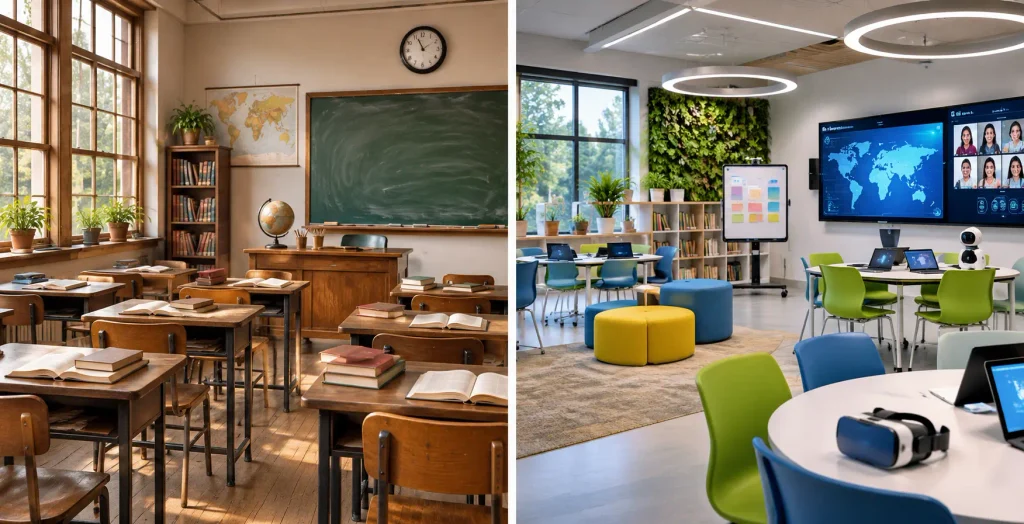
Traditional classroomTeacher-led instruction, textbooks, and structured lessons.
Modern collaborative classroomGroup work, interactive technology, and flexible learning activities.
Traditional education is often associated with teacher-led lessons, structured curricula, textbooks, memorization, and written examinations.
Modern educational approaches frequently emphasize active learning, student participation, collaboration, creativity, and the thoughtful use of technology.
In practice, most schools combine elements of both.
Traditional vs. modern education comparison
| Feature | Traditional approach | Modern approach |
|---|---|---|
| Teacher’s role | Primary instructor | Instructor, guide, facilitator |
| Student’s role | Listen, practice, respond | Participate, investigate, create |
| Classroom layout | Often rows of desks | Flexible groups or learning zones |
| Learning materials | Textbooks and notebooks | Print, digital, and hands-on resources |
| Assessment | Mainly tests and examinations | Tests, projects, portfolios, feedback |
| Collaboration | Sometimes limited | Often emphasized |
| Technology | Optional or limited | Integrated when useful |
| Personalization | Mostly common instruction | More differentiated support |
These are broad tendencies rather than strict definitions.
Is modern education always better?
No. Effective teaching is more important than whether a classroom looks traditional or futuristic.
Direct instruction can be highly effective when introducing unfamiliar concepts. Independent projects can be valuable when students are ready to apply knowledge.
Similarly, a digital screen does not automatically improve learning.
UNESCO’s 2023 Global Education Monitoring Report warned that strong independent evidence for the educational benefits of some technologies remains limited. Technology should support educational goals rather than determine them. UNESCO Documents
What does an effective classroom combine?
A balanced learning environment might include clear teacher explanations, guided practice, student discussion, creative projects, regular feedback, and appropriate digital tools.
For example, a mathematics teacher could first explain fractions, demonstrate examples, allow students to explore fraction models, and then provide independent exercises.
Technology might help students visualize fractions, but physical manipulatives and paper worksheets can be equally valuable.
The goal is not to replace traditional teaching. It is to improve learning.
7. Which Countries Have the Best Education Systems?
This is one of the most frequently discussed questions in international education.
However, there is no single universally accepted ranking of the world’s best school systems.
The answer depends on what we measure.
A country may perform strongly in mathematics while facing challenges in student well-being. Another may prioritize educational equity but achieve more modest results in standardized assessments.
What is PISA?
The Programme for International Student Assessment, or PISA, is an international assessment organized by the Organisation for Economic Co-operation and Development (OECD).
It examines how well 15-year-old students can apply knowledge and skills in areas including mathematics, reading, and science.
PISA results provide useful international comparisons, but they do not measure every dimension of educational quality.
What do the latest PISA results show?
The PISA 2025 results identify strong performance in several East Asian education systems, including Singapore, Japan, Korea, Macao (China), and Chinese Taipei. Estonia also performs strongly, particularly among European systems. OECD+1
Selected PISA 2025 mathematics scores
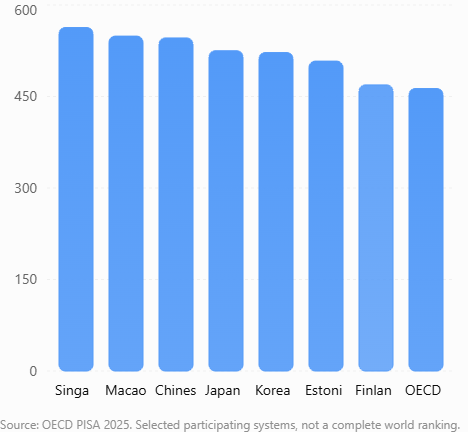
These are selected results, not an overall ranking of school quality. PISA 2025 also reports results for participating Chinese regions separately from China as a whole.
What can other countries learn?
Rather than copying one country’s school system, policymakers and educators can examine successful practices and adapt them to local conditions.
Useful areas of study include teacher preparation, early literacy, curriculum coherence, student support, school leadership, educational equity, and assessment design.
Why test scores are not enough
A meaningful evaluation of an education system should consider multiple indicators:
- Academic learning and foundational skills
- Student well-being and safety
- Educational access and inclusion
- Equity between socioeconomic groups
- Teacher quality and professional support
- Completion and graduation rates
- Opportunities for creativity and practical learning
The strongest education systems should aim to help all students learn, not simply produce a small number of high-performing test-takers.
8. The Biggest Challenges Facing Schools Around the World
Despite decades of progress, access to quality education remains unequal.
Some children learn in well-equipped classrooms with libraries, laboratories, and reliable internet connections. Others attend overcrowded schools, travel long distances, or lack essential educational materials.
Challenge 1: Children who are not attending school
According to UNESCO’s 2026 Global Education Monitoring Report, approximately 273 million children, adolescents, and young people of primary and secondary school age were out of school in 2024.
79M
Primary age
64M
Lower secondary age
130M
Upper secondary
Estimated out-of-school population worldwide in 2024. Source: UNESCO Global Education Monitoring Report 2026.
Barriers can include poverty, conflict, displacement, disability-related exclusion, discrimination, and limited school infrastructure.
Challenge 2: Inequality in educational opportunities
Students do not always begin school with the same resources.
Some have access to books, computers, tutoring, and quiet study spaces. Others may face financial difficulties, transportation problems, or limited learning materials.
Education policies that address these differences can help create fairer opportunities.
Challenge 3: Teacher shortages and support
Teachers are central to successful education.
Yet many systems struggle with recruitment, professional development, workload, working conditions, and retaining experienced educators.
Investing in teacher preparation and support is therefore essential.
Challenge 4: The digital divide
Digital learning can expand access to information, but not every student has reliable internet connectivity or a suitable device.
Technology-based education may deepen existing inequalities when schools assume that every family has the same digital resources.
Challenge 5: Student well-being
Academic achievement matters, but schools must also consider students’ emotional and social development.
Excessive pressure, bullying, discrimination, and inadequate support can interfere with learning.
A supportive school environment encourages students to ask questions, seek help, and develop confidence.
Challenge 6: Preparing students for a changing world
Education systems must respond to evolving technologies, labor markets, environmental challenges, and social needs.
This requires updating curricula while protecting foundational skills.
Students still need strong literacy and numeracy, even as digital literacy, critical thinking, and adaptability become increasingly important.
9. The Future of Schooling: AI, Technology, and New Learning Models
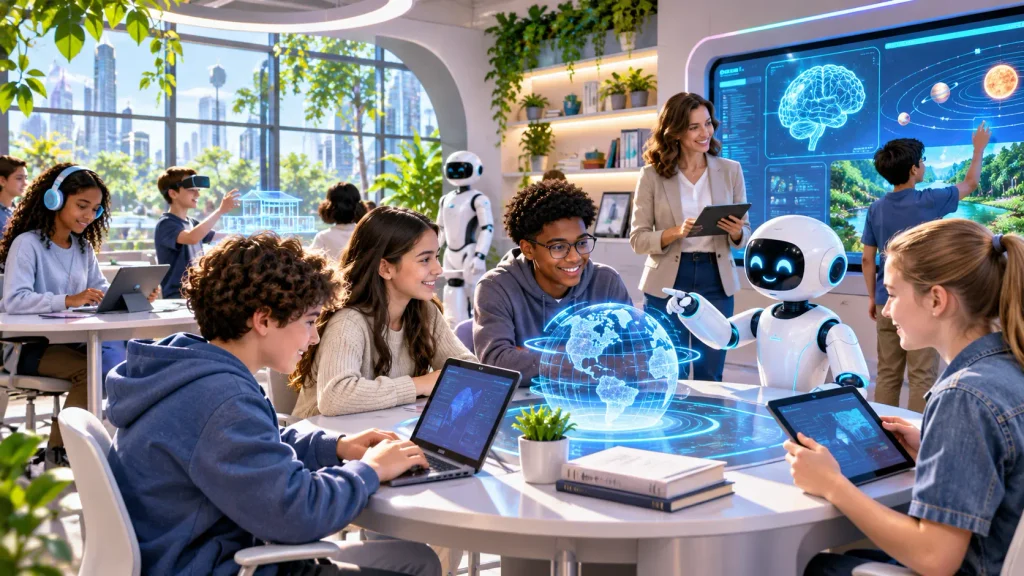
What will schools look like in the future?
Will students still sit in classrooms? Will artificial intelligence replace teachers? Will traditional examinations disappear? Could virtual reality make it possible to explore ancient civilizations or distant planets without leaving school?
These questions are becoming increasingly important as education systems adapt to technological and social change.
The future of schooling is unlikely to involve one universal model. Instead, schools may combine physical classrooms, digital resources, personalized instruction, and new forms of collaboration.
9.1 Artificial intelligence in education
Artificial intelligence is already influencing educational tools, including writing assistance, translation, accessibility features, tutoring applications, and learning analytics.
In the future, AI-supported systems may help teachers identify learning gaps, prepare differentiated exercises, and provide additional practice opportunities.
Imagine a classroom where students are learning fractions.
One student needs more practice with equivalent fractions. Another is ready for word problems. A third benefits from visual explanations.
An AI-supported platform might recommend different activities while the teacher monitors progress, explains difficult concepts, and provides personal guidance.
The most promising role for AI is to support teachers and learners, not replace the human relationships at the center of education.
Schools must also address important concerns, including student privacy, inaccurate AI-generated answers, bias, accessibility, and overreliance on automated tools.
9.2 Personalized learning
Traditional classrooms often require students to move through a curriculum at approximately the same pace.
Personalized learning attempts to respond to differences in students’ needs, interests, and progress.
Future learning platforms may provide adaptive exercises, immediate feedback, and flexible practice.
However, personalization should not isolate students or prevent them from experiencing shared lessons and collaborative learning.
9.3 Virtual and augmented reality
Virtual reality (VR) and augmented reality (AR) may offer new ways to explore subjects.
Potential educational applications include virtual museum visits, interactive anatomy lessons, historical reconstructions, and three-dimensional scientific models.
For example, students studying the solar system could examine a digital representation of planetary orbits.
Such experiences could complement books, experiments, and teacher explanations.
Their effectiveness will depend on instructional design, accessibility, cost, and evidence of actual learning benefits.
9.4 Hybrid and blended learning
Blended learning combines face-to-face instruction with digital activities.
Students might attend regular classroom lessons while using online platforms for homework, revision, and additional practice.
Hybrid arrangements can also combine in-person and remote participation, although these models require careful planning.
The goal should be flexibility without sacrificing social interaction, educational quality, or inclusion.
9.5 Robotics and coding
Robotics can introduce students to programming, engineering, mathematics, and problem-solving.
A classroom robotics project might ask students to design a small machine, test its movement, identify errors, and improve its performance.
Such activities encourage experimentation and collaboration.
However, schools do not need expensive robots to teach computational thinking. Unplugged coding activities, logic games, and paper-based challenges can also develop important skills.
9.6 Project-based learning
Project-based learning organizes instruction around meaningful questions or challenges.
Instead of studying environmental science only through textbook exercises, students might investigate water use at their school, collect data, create graphs, and propose improvements.
Projects can connect several subjects and encourage students to apply knowledge.
They work best when teachers provide clear academic goals, guidance, and assessment criteria.
9.7 The future role of teachers
Teachers may increasingly work with digital systems, but their responsibilities will remain deeply human.
They will continue to explain concepts, motivate students, build relationships, recognize learning difficulties, and create supportive classroom environments.
As information becomes easier to access, helping students evaluate that information may become even more important.
The teacher of the future may be an instructor, mentor, learning designer, and guide to responsible technology use.
10. Schools in 2030, 2040, and 2050: What Might Education Look Like?
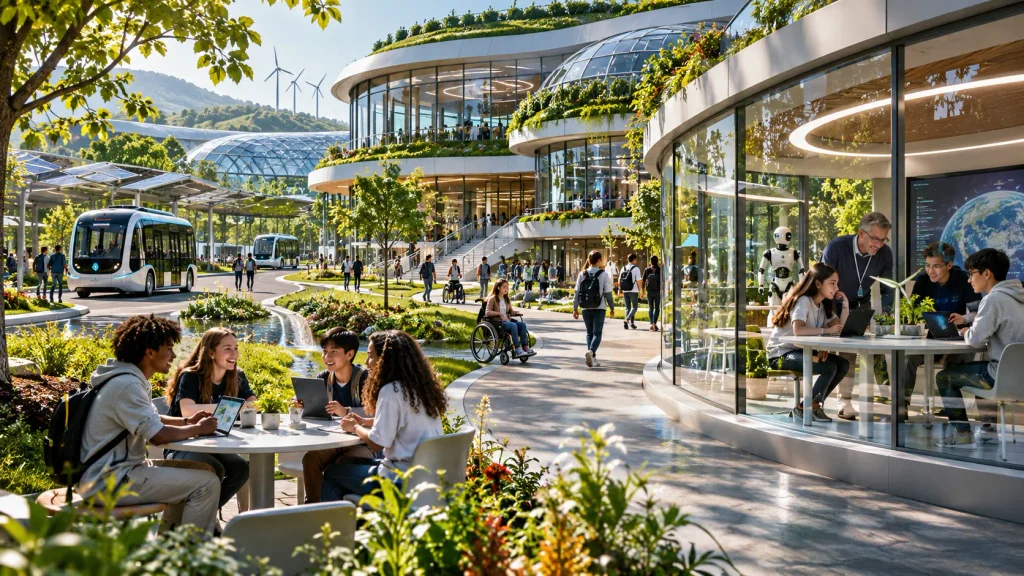
Predicting education decades into the future is difficult.
Technological breakthroughs, economic conditions, political decisions, and cultural priorities could all change the direction of schooling.
The following scenarios are possibilities, not guaranteed outcomes.
2030
More connected classrooms
Schools may expand the use of AI-assisted lesson preparation, adaptive practice, digital accessibility tools, and blended learning.
Teacher training, data protection, and responsible AI policies will be essential.
2040
More flexible learning pathways
Some education systems may offer increasingly personalized learning routes, digital portfolios, interdisciplinary projects, and closer connections between schools and community organizations.
Recognition of different learning achievements could become more flexible.
2050
Schools designed for lifelong learning
Education could become more closely connected to lifelong professional development, advanced simulations, sustainable infrastructure, and international collaboration.
Physical schools may remain important places for friendship, mentorship, creativity, and community life.
Will AI replace schools?
Complete replacement of schools by artificial intelligence appears unlikely to be a desirable goal.
Schools provide much more than information.
They offer social relationships, structured support, physical activities, practical experiences, and opportunities to participate in a community.
AI may change how lessons are prepared and delivered, but it cannot automatically reproduce every educational, social, and developmental function of a school.
Will students still need textbooks?
Printed textbooks may coexist with interactive digital materials.
Books remain useful because they are portable, relatively accessible, and do not require electricity or internet access.
Digital resources offer other advantages, including search functions, multimedia, and accessibility features.
A balanced education system can benefit from both.
Will examinations disappear?
Examinations may evolve, but assessment is likely to remain necessary.
Schools need ways to understand what students know, identify learning difficulties, and certify achievements.
Future assessment systems may combine written examinations with projects, practical demonstrations, portfolios, and teacher evaluations.
What skills will students need in 2050?
Future generations will likely benefit from a combination of traditional and emerging competencies.
| Foundational skills | Future-oriented skills |
|---|---|
| Reading and writing | Digital and AI literacy |
| Mathematics | Computational thinking |
| Scientific understanding | Evaluating information |
| Communication | Cross-cultural collaboration |
| Reasoning | Adaptability |
| Creativity | Responsible technology use |
| Civic understanding | Environmental literacy |
Rather than teaching only the tools available today, schools should help students develop the ability to learn throughout their lives.
11. How to Choose the Right School for Your Child
Choosing a school is one of the most important educational decisions a family may make.
But the most expensive school, the most technologically advanced school, or the school with the highest examination scores is not necessarily the best choice for every child.
Families should consider academic quality alongside safety, accessibility, student support, and individual learning needs.
Questions parents should ask
School selection checklist
☐ Is the school officially recognized or accredited where required?
☐ Are teachers appropriately qualified and supported?
☐ Does the curriculum match the child’s learning needs?
☐ How does the school support students who need extra help?
☐ Is the learning environment safe, respectful, and inclusive?
☐ How does the school communicate with parents?
☐ Are fees, transportation, and other costs manageable?
☐ Does the school offer appropriate arts, sports, and extracurricular activities?
☐ How does the school evaluate student progress?
☐ Does the child feel comfortable and supported in the environment?
Look beyond school rankings
Rankings may provide useful information, but they rarely capture the complete student experience.
A school visit can reveal how teachers interact with children, how classrooms are organized, and whether the environment feels welcoming.
Parents can also ask about learning support, disciplinary policies, student well-being, and communication practices.
Consider the child’s individual needs
Some children thrive in highly structured environments. Others benefit from more hands-on activities or additional academic support.
A child who enjoys science experiments may appreciate a school with strong laboratory facilities. A student interested in music may value a well-developed arts program.
The aim is to find an environment where the child can learn, participate, and grow.
Remember that learning continues at home
A supportive home learning environment can complement school education.
Families can encourage reading, discuss school experiences, provide appropriate study routines, and make learning materials available.
Simple educational resources, including printable worksheets, flashcards, reading activities, and mathematics games, can help reinforce classroom learning.
At ALITEXTO, we believe that useful learning resources should support both teachers and families, whether learning happens in a traditional classroom, an international school, or at home.
12. Frequently Asked Questions About Schools Around the World
What are the main types of schools?
The main categories include public schools, private schools, international schools, religious schools, boarding schools, vocational schools, and online schools. Montessori and Waldorf schools are examples of educational approaches, while homeschooling is a form of education outside conventional school attendance.
Which country has the best education system?
There is no universally agreed best education system. International assessments such as PISA compare specific learning outcomes, while broader evaluations also consider educational access, student well-being, equity, and teacher support.
What is the difference between public and private schools?
Public schools are generally funded or operated by government authorities, while private schools are independently managed. Funding, admissions, curricula, and fees vary according to national regulations.
What is an international school?
An international school typically offers an internationally oriented or foreign curriculum. Such schools may serve students from different nationalities and families seeking internationally recognized educational pathways.
At what age do children start school?
Formal primary education commonly begins between ages five and seven, depending on the country. Many children attend preschool or pre-primary education before entering primary school.
What is the difference between Montessori and traditional education?
Montessori education typically emphasizes hands-on materials, independence, and self-directed activities within a prepared environment. Traditional approaches often rely more heavily on teacher-led lessons and structured instruction. Individual schools may combine elements of both.
Are private schools better than public schools?
Not necessarily. School quality depends on teaching, leadership, resources, inclusion, student support, and other factors. Both public and private schools can provide excellent education.
What are the biggest problems facing education worldwide?
Major challenges include unequal access, poverty, teacher shortages, learning gaps, conflict-related disruption, digital inequality, and differences in educational resources.
How is artificial intelligence changing education?
AI can support personalized practice, lesson preparation, translation, accessibility, and feedback. Its use also creates concerns about privacy, reliability, bias, and students’ independent thinking.
Will schools exist in 2050?
Schools are likely to continue existing, although their organization and technologies may change. Physical learning environments remain important for social development, practical activities, and relationships with teachers and peers.
Is online school as effective as traditional school?
Online education can be effective when instruction is well designed and students receive appropriate support. Outcomes depend on the learner, curriculum, teaching quality, technology access, and opportunities for interaction.
What skills should schools teach for the future?
Schools should continue developing literacy, numeracy, scientific knowledge, and communication while also supporting critical thinking, creativity, collaboration, digital literacy, and responsible use of technology.
Conclusion: The Future of Education Begins With Better Learning Opportunities
Schools around the world may look different, follow different curricula, and use different teaching methods, but they share a fundamental responsibility: preparing young people to participate meaningfully in society.
From traditional classrooms to international schools, from Montessori environments to emerging AI-supported learning systems, every educational approach offers opportunities and challenges.
The future of schooling should not be measured simply by how many computers, robots, or digital platforms appear in classrooms.
It should be measured by how effectively schools help students learn, develop confidence, build relationships, and access meaningful opportunities.
Technology can support this mission, but good teachers, inclusive policies, strong foundations, and supportive communities will remain essential.
The school of the future should not simply be more technological. It should be more accessible, effective, inclusive, and human-centered.
At ALITEXTO, our goal is to support that vision by making educational ideas, printable learning resources, and practical teaching materials accessible to families, students, and educators.
Explore our learning resources at ALITEXTO and discover new ways to make learning engaging, meaningful, and accessible.
Sources and further reading
The following authoritative resources support the article’s international comparisons and discussion of education trends.
- OECD — Education at a Glance 2025. International comparisons of education structures, participation, funding, and learning environments. OECD Education at a Glance
- OECD — PISA 2025 Results. Comparative student performance in science, mathematics, reading, and computational problem-solving. PISA 2025 Executive Summary
- UNESCO — Global Education Monitoring Report 2026. Global participation, completion, and progress toward Sustainable Development Goal 4. UNESCO Education Monitoring
- UNESCO — Global Education Monitoring Report 2023: Technology in Education. Research on educational technology, equity, and evidence of effectiveness. Technology in Education Report
- UNESCO Institute for Statistics. International education indicators and data resources. UNESCO UIS
Editorial note: Country descriptions summarize national systems and may not capture all regional differences or ongoing reforms. The 2030–2050 scenarios are projections, not established facts. Country-specific admission requirements and legal rules should always be verified with relevant education authorities.
