


ALITEXTO | Teaching Strategies • Classroom Management • Student Well-Being
A great teacher does more than explain lessons, assign homework, and evaluate academic progress. Great teachers create environments where students feel respected, encouraged, understood, and motivated to learn.
Think about a teacher who made a difference in your life. Perhaps they encouraged you when you struggled with a difficult subject, listened when you needed support, or helped you discover a talent you didn’t know you had.
Often, what makes these teachers memorable is not simply what they taught, but how they made learning feel possible.
The teacher–student relationship is one of the foundations of effective education. It influences classroom participation, motivation, behavior, emotional well-being, and students’ attitudes toward school.
Whether you teach preschool children, elementary students, or teenagers, developing positive relationships can transform the classroom experience.
In this comprehensive guide, you’ll discover why teacher–student relationships matter, what educational research tells us, the challenges teachers face, and 15 practical strategies for creating stronger connections with students.
1. What Is a Teacher–Student Relationship?
A teacher–student relationship is the professional connection between an educator and a learner. It develops through daily interactions, communication, classroom experiences, expectations, and mutual respect.
Positive relationships are characterized by several essential qualities:
- Trust: Students believe their teacher is dependable, fair, and supportive.
- Respect: Teachers recognize students’ dignity, backgrounds, abilities, and individual perspectives.
- Empathy: Teachers seek to understand students’ experiences without making assumptions.
- Communication: Students feel able to ask questions and express their learning needs.
- Consistency: Expectations and classroom routines are predictable.
- Encouragement: Teachers recognize effort, improvement, creativity, and perseverance.
- Healthy boundaries: Teachers maintain appropriate professional roles and safeguard students’ well-being.
A positive relationship does not mean that teachers must become friends with their students or eliminate discipline. Effective relationships combine kindness with structure, encouragement with accountability, and flexibility with consistent expectations.
The goal is to create an environment where students feel valued as individuals while understanding their responsibilities as learners.
2. Why Is the Teacher–Student Relationship Important?
2.1 It increases student engagement
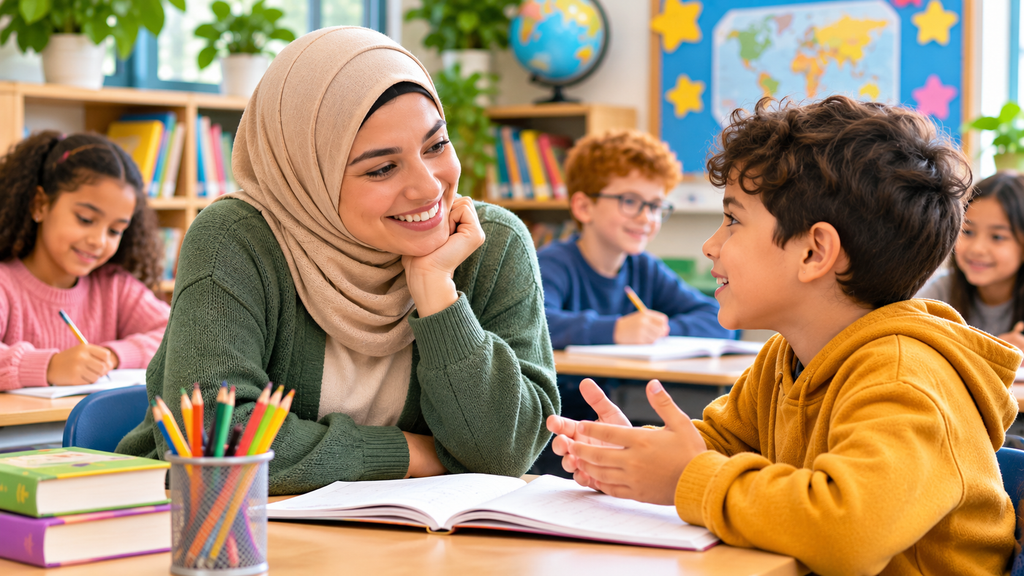
Student engagement refers to how actively learners participate in educational activities.
Engaged students are more likely to ask questions, contribute to discussions, complete assignments, and persist when tasks become challenging.
Imagine two classrooms.
In the first, students worry that incorrect answers will lead to embarrassment. They hesitate to participate, even when they have useful ideas.
In the second, the teacher welcomes questions, treats mistakes as learning opportunities, and encourages respectful discussion.
Students in the second classroom may feel more comfortable participating because they know their contributions will be treated respectfully.
This sense of psychological safety is particularly important when students encounter unfamiliar or challenging concepts.
2.2 It supports academic achievement
Positive relationships can support learning by encouraging motivation, persistence, and help-seeking.
A student who trusts their teacher may be more willing to admit that they don’t understand a lesson.
This gives the teacher an opportunity to identify misconceptions and provide appropriate instruction.
However, supportive relationships are not a substitute for effective teaching. Academic achievement also depends on curriculum quality, instructional methods, resources, practice, and individual circumstances.
The strongest classrooms combine high-quality instruction with supportive relationships.
2.3 It improves classroom behavior
Classroom management is not simply about enforcing rules. It also involves building a respectful learning community.
When students understand expectations and believe they will be treated fairly, they may be more willing to cooperate.
Positive relationships help teachers address behavior through communication, clear boundaries, and constructive guidance.
For example, instead of publicly criticizing a student who repeatedly interrupts, a teacher might speak with them privately, explain the impact of interruptions, and agree on a strategy for participating appropriately.
This approach maintains accountability without unnecessary embarrassment.
2.4 It promotes emotional well-being
Children and teenagers experience many emotions throughout the school day, including excitement, frustration, disappointment, uncertainty, and pride.
Supportive teachers can help students develop emotional awareness and a sense of belonging.
Small interactions matter. Greeting a student, acknowledging their progress, or responding patiently to a question can contribute to a more welcoming school environment.
Teachers are not expected to replace families, counselors, or mental health professionals. Their role is to create supportive educational conditions and follow school safeguarding procedures when additional help is needed.
2.5 It develops confidence and independence
Students need opportunities to try unfamiliar tasks, make decisions, and learn from mistakes.
Teachers can support this process by providing encouragement without removing every challenge.
For example, rather than immediately solving a difficult mathematics problem, a teacher could ask:
“What have you tried so far?”
“Which part of the problem makes sense to you?”
“What strategy could we test next?”
These questions communicate confidence in the student’s ability to think and develop solutions.
Over time, such experiences can strengthen independence and problem-solving skills.
3. What Does Research Say About Teacher–Student Relationships?

Educational research supports the importance of positive interactions between teachers and students.
A widely cited meta-analysis by Roorda and colleagues (2011) examined research on affective teacher–student relationships and their associations with school engagement and achievement.
The findings indicated that positive relationships were associated with stronger student engagement and academic outcomes, while negative relationships were associated with less favorable outcomes.
A later meta-analysis by Quin (2017) also examined links between teacher–student relationships and student engagement.
These findings suggest that relationships deserve attention alongside instructional quality and classroom organization.
However, much of this evidence is correlational. A positive relationship may contribute to engagement, while engaged students may also find it easier to develop positive relationships with teachers.
It is therefore more accurate to describe relationships as an important part of a successful learning environment rather than a guaranteed solution to every educational challenge.
4. Fifteen Practical Strategies for Building Positive Teacher–Student Relationships
Strategy 1: Greet every student warmly
A welcoming greeting at the classroom door can establish a positive tone.
Use students’ preferred names and offer a brief, respectful welcome.
A simple “Good morning, it’s good to see you” can help students feel acknowledged.
Strategy 2: Learn about students’ interests
Students bring different experiences, talents, cultures, and interests into the classroom.
Some enjoy reading, others love drawing, sports, science, animals, technology, or music.
Learning about these interests can help teachers design relevant examples and activities.
Try an All About Me worksheet at the beginning of the school year, asking students about their favorite subjects, interests, and learning preferences.
Allow students to skip personal questions they do not wish to answer.
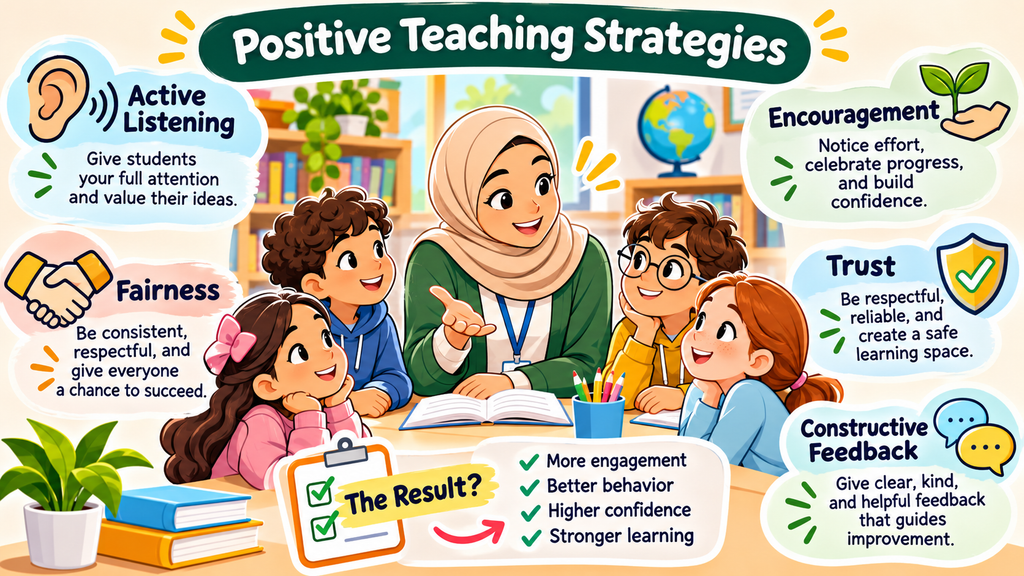
Strategy 3: Practice active listening
Listening involves more than waiting for a student to finish speaking.
Give students appropriate attention, avoid unnecessary interruptions, and ask clarifying questions.
If a student says, “I can’t do this assignment,” try responding with:
“Which part feels difficult? We can look at it together.”
This focuses on understanding the learning obstacle rather than dismissing the student’s concern.
Strategy 4: Recognize effort and progress
Grades provide information about achievement, but they do not tell the whole story.
Students also benefit from feedback about improvement, persistence, and effective strategies.
Instead of saying only “Excellent work,” try:
“Your second paragraph is clearer because you added evidence to support your idea.”
Specific feedback helps students understand what they did successfully and how to repeat it.
Strategy 5: Make mistakes part of learning
Mistakes are a natural part of acquiring knowledge and skills.
Teachers can normalize mistakes by demonstrating how to review an incorrect answer, identify the misunderstanding, and try a different approach.
Avoid making students feel embarrassed for answering incorrectly.
A classroom that treats mistakes constructively encourages curiosity and participation.
Strategy 6: Be fair and consistent
Students notice how teachers respond to different classmates.
Unexplained differences in treatment can weaken trust.
Establish clear expectations, explain classroom rules, and apply them consistently while allowing reasonable accommodations for individual learning needs.
Fairness does not always mean giving every student identical support. It means providing appropriate opportunities for everyone to succeed.
Strategy 7: Create opportunities for student voice
Students benefit from having meaningful opportunities to contribute to their learning environment.
Teachers might invite students to select a reading topic, suggest a class project, or provide feedback on an activity.
Choices should be age-appropriate and consistent with curriculum requirements.
Even small decisions can strengthen students’ sense of responsibility.
Strategy 8: Use positive classroom language
The words teachers choose can influence how students interpret challenges.
Compare these statements:
| Instead of saying | Try saying |
|---|---|
| “You’re wrong.” | “Let’s examine that answer together.” |
| “This is easy.” | “Let’s break it into smaller steps.” |
| “You never listen.” | “I need your attention while I explain.” |
| “You’re so smart.” | “Your strategy helped you solve that problem.” |
| “Stop making mistakes.” | “Check this step and try again.” |
Supportive language should remain clear and authentic. Students still need direct feedback when their work or behavior requires improvement.
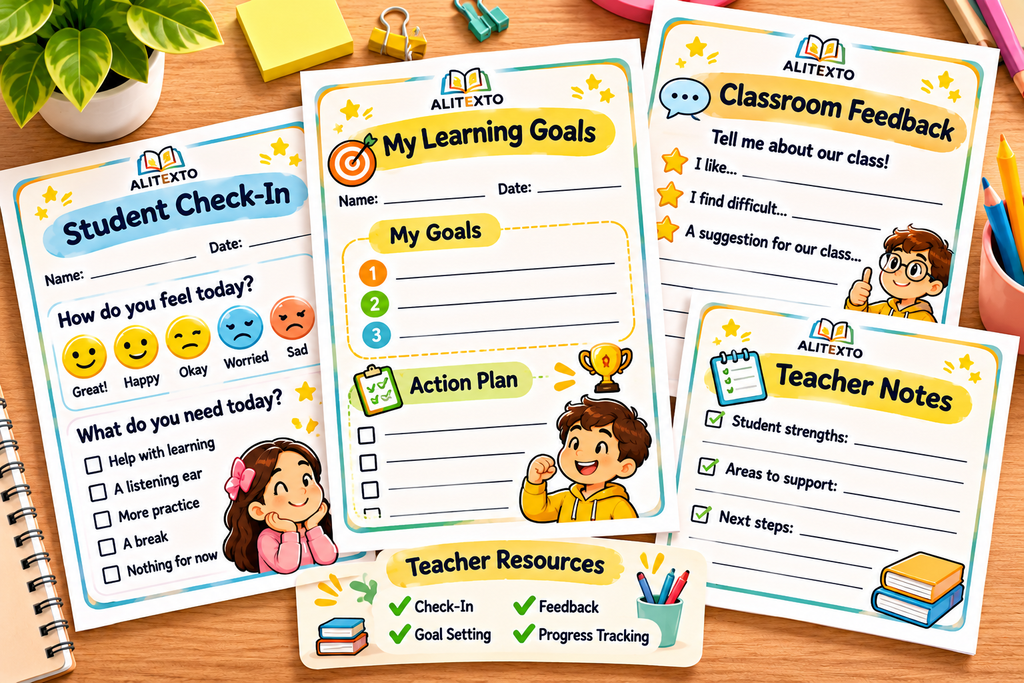
Strategy 9: Check in regularly
A short check-in can help teachers identify learning needs and classroom concerns.
For younger students, use simple feeling cards or visual scales.
Older students may prefer brief written reflections or private conversations.
Avoid requiring students to reveal personal emotions in front of classmates.
Strategy 10: Build collaborative activities
Group projects, partner reading, classroom discussions, and cooperative challenges can encourage positive interactions.
Teachers should explain group responsibilities, monitor participation, and ensure that quieter students have meaningful opportunities to contribute.
Strategy 11: Adapt teaching to different learning needs
Students differ in prior knowledge, language proficiency, pace, and support needs.
Teachers can use flexible instructional methods, including visual explanations, guided practice, hands-on activities, and alternative ways to demonstrate understanding.
Providing appropriate support shows students that their learning needs are taken seriously.
Strategy 12: Communicate with families
Families can provide useful information about students’ interests, strengths, and learning experiences.
Share positive developments as well as academic concerns.
Use school-approved communication methods and respect family circumstances, language preferences, and privacy.
Strategy 13: Address conflicts respectfully
Disagreements and behavioral challenges are inevitable.
When conflict occurs, focus on the behavior rather than labeling the student.
Explain what happened, why it matters, and what needs to change.
Where appropriate, provide opportunities to repair harm and rebuild trust.
Strategy 14: Maintain professional boundaries
Strong relationships are supportive, not overly personal.
Teachers should use approved communication channels, respect confidentiality, avoid favoritism, and follow school safeguarding policies.
Students should understand that teachers care about their educational well-being while maintaining appropriate professional responsibilities.
Strategy 15: Reflect on your teaching practices
Relationship-building requires ongoing reflection.
At the end of each week, consider:
- Which students participated actively?
- Which students may need additional encouragement?
- Did I respond fairly to classroom challenges?
- Did I recognize improvement?
- What could I do differently next week?
Reflective practice helps teachers identify patterns and make thoughtful improvements.
5. Teacher–Student Relationship Activities for Different Age Groups
Relationship-building activities should reflect students’ ages, developmental needs, and classroom context.
| Age group | Activity | Learning benefit |
|---|---|---|
| Preschool (3–5) | Feelings picture cards | Emotional vocabulary |
| Early elementary (6–8) | All About Me worksheet | Self-expression |
| Upper elementary (9–11) | Weekly learning reflection | Confidence and goal-setting |
| Middle school (12–14) | Anonymous classroom feedback | Student voice |
| High school (15–18) | Personal academic goal planning | Independence and responsibility |
Preschool: Feelings check-in
Provide cards showing simple emotions such as happy, sad, excited, worried, and calm.
Invite children to select a card if they wish.
Teachers can model emotional vocabulary and respond sensitively without requiring personal explanations.
Elementary school: All About Me
Give students a worksheet with prompts such as:
- My favorite school subject is…
- Something I enjoy learning about is…
- One thing I want my teacher to know about how I learn is…
- This year, I want to improve…
Teachers can use the responses to personalize instruction and identify shared interests.
Middle school: Classroom feedback
Offer a short anonymous survey asking students what helps them learn, which classroom activities they find useful, and what could be improved.
Discuss general themes without attempting to identify individual respondents.
High school: Academic goal-setting
Encourage students to establish achievable learning goals.
For example, a student might aim to improve essay organization by using an outline before drafting.
Teachers can review progress periodically and help students adjust strategies.
6. How to Build Trust With Students Who Are Difficult to Reach
Not every student immediately feels comfortable interacting with a teacher.
Some may be shy, unfamiliar with the classroom language, adjusting to a new school, or cautious because of previous experiences.
Trust should develop gradually.
Begin with predictable, respectful interactions. Offer low-pressure participation options, provide clear instructions, and recognize small achievements.
For example, a student who rarely speaks in class might initially prefer submitting a written response rather than answering aloud.
Providing alternatives can help the student participate without unnecessary pressure.
Avoid assuming that a quiet student is disengaged or that a student displaying challenging behavior lacks motivation.
Understanding the context is an important part of choosing an appropriate response.
7. The Connection Between Teacher–Student Relationships and Classroom Management
Effective classroom management combines three elements: relationships, structure, and instruction.
Relationships help students feel connected to the classroom community.
Structure provides predictable routines and clear expectations.
Instruction keeps students meaningfully engaged in learning.
These elements reinforce one another.
A teacher who builds strong relationships but provides no clear expectations may struggle to maintain a productive learning environment.
Similarly, a teacher who emphasizes rules without respect or communication may find that students become reluctant to participate.
The goal is a balanced classroom where students experience both support and accountability.
8. Teacher–Student Relationships in Online and Digital Classrooms
Digital learning creates additional opportunities and challenges.
Teachers may communicate through learning management systems, virtual lessons, digital assignments, and feedback tools.
Positive online relationships depend on clear communication, accessibility, respectful interactions, and consistent expectations.
Helpful practices include providing timely feedback, explaining digital tasks clearly, encouraging questions, and checking whether students can access required materials.
Teachers should use school-approved platforms, protect personal information, and maintain professional communication boundaries.
Technology can improve access to learning, but it should support meaningful teacher–student interactions rather than replace them.
9. Common Challenges and How to Overcome Them
Large class sizes
Teachers with many students may find individual conversations difficult.
Brief greetings, rotating check-ins, and structured reflection activities can help make personal attention more manageable.
Limited teaching time
Relationship-building does not always require separate lessons.
It can be integrated into existing routines, feedback, discussions, and transitions.
Student behavior challenges
Respond to behavior with clear expectations and appropriate consequences while preserving the student’s dignity.
Seek additional school support when difficulties are persistent or complex.
Cultural and language differences
Avoid making assumptions about students’ experiences.
Use inclusive materials, communicate clearly, and seek to understand cultural differences respectfully.
Teacher stress and workload
Teachers also need support, reasonable expectations, and opportunities for professional collaboration.
Relationship-building should not become another impossible demand. Small, consistent practices are often more sustainable than elaborate activities.
10. How to Know Whether Your Classroom Relationships Are Improving
Positive relationships cannot be measured accurately through a single test or survey.
However, teachers can observe patterns over time.
Useful indicators may include students asking for help more comfortably, participating more consistently, demonstrating greater cooperation, and expressing a stronger sense of belonging.
Teachers can also use anonymous student feedback, classroom observations, and reflective notes.
Remember that students express trust differently. A quiet student may feel secure and engaged even without frequent verbal participation.
11. Frequently Asked Questions
Why is the teacher–student relationship so important?
It supports a respectful learning environment where students may feel more motivated, confident, engaged, and comfortable seeking help.
How can teachers build better relationships with students?
Teachers can build relationships through consistent communication, fairness, active listening, constructive feedback, encouragement, and appropriate professional boundaries.
Do teacher–student relationships affect academic performance?
Research has found positive associations between supportive relationships, student engagement, and academic achievement. However, academic success depends on multiple factors.
How can teachers connect with students who do not participate?
Offer alternative participation methods, provide encouragement privately, and identify potential barriers without making assumptions.
Can teachers be friendly without becoming students’ friends?
Yes. Teachers can be approachable, kind, and supportive while maintaining clear professional boundaries and expectations.
What activities help strengthen teacher–student relationships?
Morning check-ins, student interest surveys, goal-setting worksheets, collaborative projects, and classroom feedback activities can all provide opportunities for connection.
12. Conclusion: Relationships Are at the Heart of Great Teaching
A positive teacher–student relationship is not created in a single lesson. It develops through repeated experiences of trust, respect, fairness, encouragement, and meaningful communication.
Students benefit when teachers recognize their individuality, provide clear expectations, and support them through both successes and challenges.
For educators, building strong relationships does not require perfection. It requires consistency, reflection, and a commitment to creating classrooms where students feel respected and capable of learning.
The most effective teaching connects academic expectations with genuine respect for every learner.
At ALITEXTO, we believe that practical educational resources can help teachers create engaging, supportive, and inclusive learning experiences.
Explore our printable worksheets, classroom activities, and teaching resources to bring more creativity and meaningful learning into your classroom.
References and further reading
- Roorda, D. L., Koomen, H. M. Y., Spilt, J. L., & Oort, F. J. (2011). The Influence of Affective Teacher–Student Relationships on Students’ School Engagement and Achievement: A Meta-Analytic Approach. Review of Educational Research, 81(4), 493–529.
- Quin, D. (2017). Longitudinal and Contextual Associations Between Teacher–Student Relationships and Student Engagement: A Systematic Review. Review of Educational Research, 87(2), 345–387.
- Hamre, B. K., & Pianta, R. C. (2001). Early Teacher–Child Relationships and the Trajectory of Children’s School Outcomes Through Eighth Grade. Child Development, 72(2), 625–638.
