

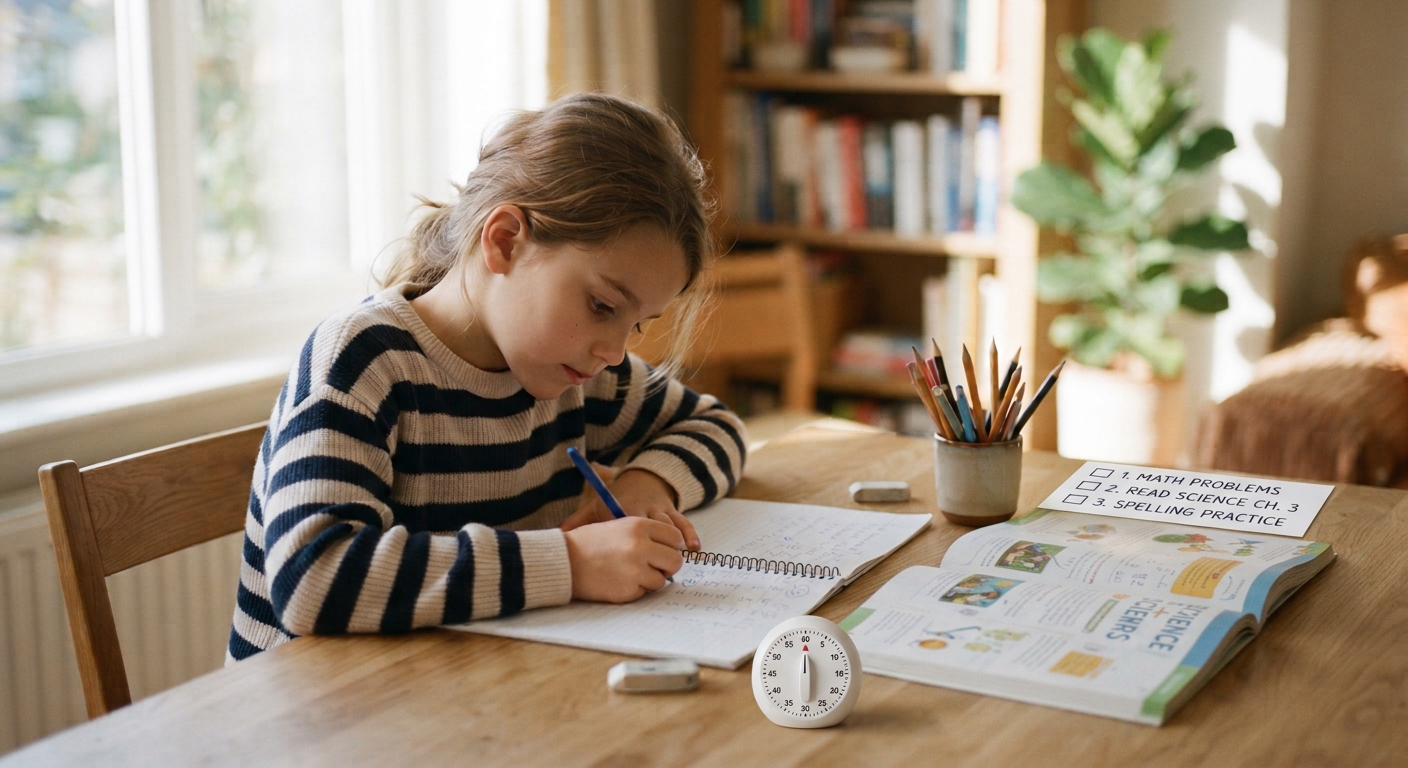
It’s 5 p.m. The backpack is still zipped, your child is suddenly very interested in the ceiling, and you can already feel the evening heading toward tears. Sound familiar?
If your child hates homework, you are far from alone. Homework battles are one of the most common worries parents have, and they can wear everyone out. The good news is that most of the time, there’s a reason behind the refusal, and once you find it, things can get a lot easier.
This guide explains why children push back against homework and gives you 12 calm, practical ideas to try at home, starting tonight.
Why Does My Child Hate Homework?
Before trying fixes, it helps to get curious. “I hate homework” is rarely the whole story. Here are some common reasons behind it:
- They’re tired or hungry. After a full day at school, a child’s brain is simply out of fuel.
- The work feels too hard. Some children avoid homework because they’re afraid of getting it wrong.
- The work feels too easy or boring. Repetitive tasks can feel pointless.
- It feels like too much. A long list can look impossible, so a child shuts down before starting.
- They want to play. After hours of sitting, children need time to move and relax.
- Distractions get in the way. Noise, screens, or siblings can make it hard to focus.
- Something else is going on. Worries about friends, teachers, or school can show up as homework refusal.
Try asking in a relaxed moment, not in the middle of the battle: “What’s the hardest part about homework for you?” Then listen without fixing. You may be surprised by the answer.
12 Ways to Help a Child Who Hates Homework
1. Give them a break first
Most children need to unwind before they can focus. Offer a snack, a drink of water, and 20 to 30 minutes of play or movement before homework starts. Many parents find this one change cuts the arguments in half.
2. Set a regular homework time
Children feel calmer when they know what to expect. Pick a time that works for your family, like after a snack or after dinner, and keep it as steady as you can. When homework is simply “what happens at 4:30,” there’s less to argue about.
3. Create a simple homework spot
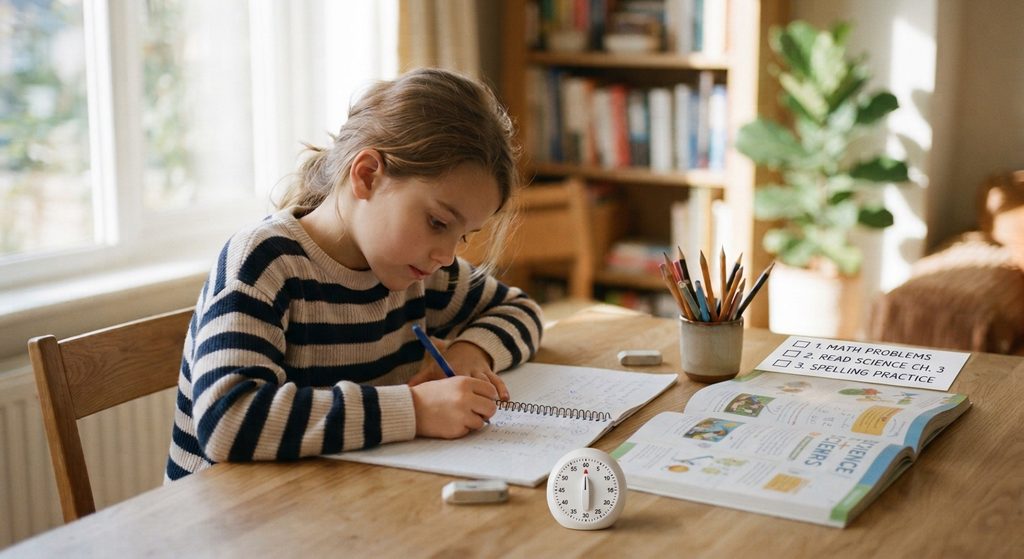
You don’t need a fancy desk. A clear table, good light, a few pencils, and a quiet corner are enough. Turn off the TV and keep phones and tablets out of reach. A tidy space helps a busy mind settle.
4. Break big tasks into small steps
A full page of math can feel like a mountain. Cover the lower half with a sheet of paper, or ask your child to do just the first three questions. Small steps feel doable, and finishing each one builds momentum.
5. Use short work sessions with breaks
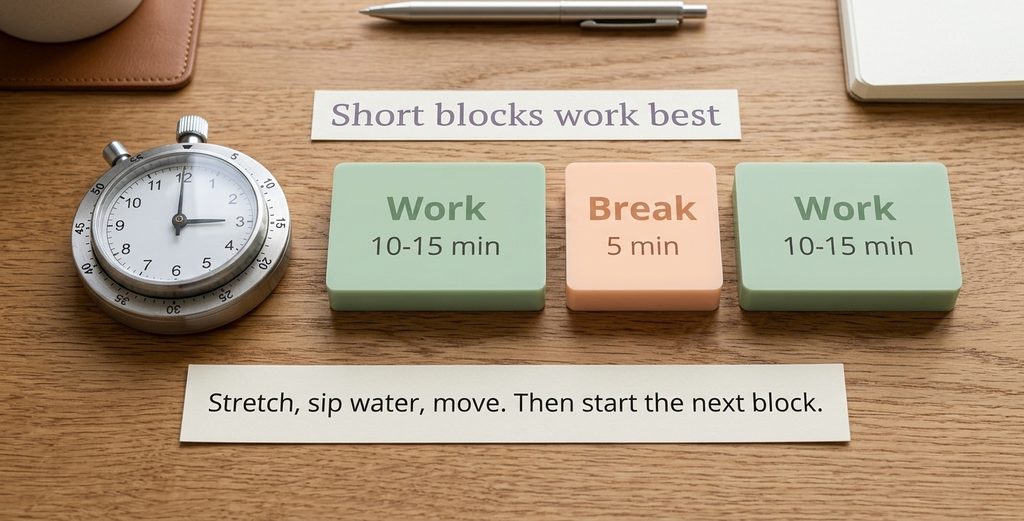
Young children can only focus for a short time. Try 10 to 15 minutes of work, then a 5-minute break to stretch, get a drink, or do a quick dance. A visible timer helps many children see that the end is coming.
6. Start with something easy
Begin with the task your child feels most confident about. A quick win warms up the brain and makes the harder work feel less scary.
7. Offer choices
Children push back when they feel controlled. Give them small choices that you’re happy with either way: “Do you want to start with reading or math?” or “Should we work at the table or on the floor?” A little control goes a long way.
8. Be nearby, but don’t do it for them
Sit close, answer questions, and keep them company, perhaps while you read or sort the mail. But resist the urge to hand over the answers or fix every mistake. Homework is how teachers learn what your child understands. If a task is too hard, it’s better to write a short note to the teacher than to finish it yourself.
9. Praise effort, not just results
“I can see you worked hard on that” builds a child who keeps trying. Notice persistence, careful work, and asking for help. Saying “You’re so smart” can accidentally make children afraid of mistakes.
10. Make learning feel like play
Not every task has to feel like work. Practice spelling words with magnetic letters or sidewalk chalk. Turn math facts into a card game. Use a small reward, like choosing the bedtime story, to celebrate finishing, but keep it simple and don’t turn it into a bribe.
11. Stay calm, even when it’s hard
Children pick up on our stress. If you feel your own frustration rising, pause. Take a breath, get a glass of water, or say, “Let’s take five minutes and come back.” A calm parent makes a calm study session much more likely.
12. Talk to the teacher
If homework is always a struggle, the teacher can help. Ask how much time homework should take, whether your child seems to struggle in class, and what support is available. Together you can adjust the amount or the approach. Sometimes a small change, like fewer questions or a different format, makes a big difference.
A Sample After-School Homework Routine
Ideas are easier to use when you can see them in order. Here’s a simple routine you can copy and change to fit your family. The times are only a guide, so adjust them to your child’s age and your evenings.
- Arrive and unwind (15 to 20 minutes). Backpack down, hands washed, snack and water. Ask about their day, but try a question other than “Do you have homework?” Something like “What was the best part of today?” keeps the mood light.
- Move your body (20 to 30 minutes). Outdoor play, a bike ride, a dance party in the living room, or just a good stretch. Moving helps tired minds reset.
- Make a plan (5 minutes). Look at the homework together. Ask, “Which one do you want to start with?” and guess how long each task will take. Having a plan makes the work feel smaller.
- Work in short blocks (10 to 15 minutes each). One subject at a time, with a timer running and you nearby.
- Take a real break (5 minutes). Water, a stretch, a few jumping jacks. Screens can wait until all the work is done.
- Finish and pack up (5 minutes). Tick off each task and put the finished homework straight into the backpack, so it isn’t lost or forgotten tomorrow morning.
- Celebrate (a few minutes). A hug, a high five, or one specific thing you noticed: “I saw how you kept going even when that question was tricky.”
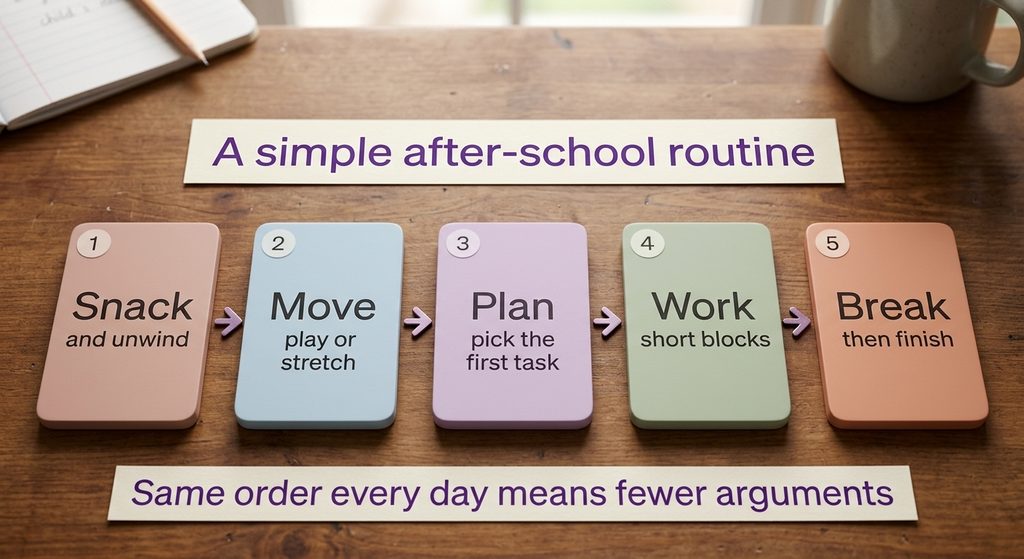
If your evenings are packed with activities, it’s fine to split homework into two short sessions, one before dinner and one after. The most important part is keeping the order steady, so your child always knows what comes next.
What to Say When Your Child Pushes Back
Sometimes the words we choose make all the difference. When your child is upset, a calm, short response works better than a long explanation. Here are some ideas you can borrow:
| When your child says… | You can try saying… |
|---|---|
| “I hate homework!” | “That sounds really frustrating. Which part feels the worst?” |
| “I don’t want to do it.” | “I hear you. Let’s do just the first three together, then take a break.” |
| “I can’t do it.” | “Show me what you’ve tried so far. What do you think the first step could be?” |
| “It’s so boring.” | “Which part is the most boring? Let’s see if you can beat the timer.” |
| “I’ll do it later.” | “Let’s pick a start time together. Would you like 4:30 or 4:45?” |
| “I’m just stupid.” | “You’re not stupid. You’re learning, and hard things take time. I’m proud that you keep trying.” |
Whatever you say, keep your voice calm and your face relaxed. Children are quick to notice sarcasm, sighs, and rolled eyes, and they can make a hard moment even harder.
Fixing Common Homework Problems
Every child struggles in a slightly different way. Here are some of the most common problems and what often helps.
My child forgets homework or leaves it at school
Start by asking the teacher how homework is shared, such as a planner, a note, or an online page. At home, use one folder just for homework, and put a short checklist inside the backpack. Make packing up part of the routine, so finished work goes straight into the bag.
My child rushes and makes careless mistakes
Rushing often means “I just want to be done.” Slow things down with the timer, and make checking a small game: “Can you find two things to fix?” Praise careful work, and ask your child to check one thing at a time, like capital letters first, then spelling.
My child puts it off and procrastinates
The hardest part is usually starting. Try the “two-minute rule”: just work for two minutes, and if they want to stop afterward, they can. Most of the time, once they’ve begun, they keep going. A visible countdown clock also helps children see that the work will end.
My child melts down or cries
Stop the task for a moment. Offer water, a few slow breaths, or a hug, and come back when everyone is calmer. Trying to push through a meltdown rarely works. If tears are a regular part of homework time, tell the teacher so you can find out why.
My child says “I don’t understand”
Ask your child to explain, in their own words, what they think the question is asking. Look at the example in their notebook or the instructions together. If they’re still stuck, avoid teaching a brand-new method, which can confuse them. Instead, write a short note to the teacher so they know where your child needs help.
Homework takes forever
Check the basics first: is your child tired, hungry, or distracted by noise or screens? Then ask the teacher how long the homework should take. If it’s regularly much longer, share that with the teacher, because it may mean the task is too hard or there’s too much of it.
Helping With Specific Subjects
Different subjects need different kinds of support. Here are a few quick ideas.
Reading homework
Sit together somewhere comfortable. Take turns reading pages, or let your child read a page and then you read the next. After reading, ask one simple question, such as “What was your favorite part?” This keeps the reading about enjoying the story, not just finishing it.
Math homework
Use real objects like buttons, coins, or blocks to make ideas easier to see. Encourage your child to draw a picture of the problem. Ask “How do you know?” instead of simply saying “Right” or “Wrong.” Understanding matters more than speed.
Writing and spelling
Ask your child to say the sentence out loud before writing it. Work on one sentence at a time. Make spelling practice playful by writing words in rainbow colors, building them with magnetic letters, or tracing them in a tray of sand or salt. Praise their ideas first, and neat handwriting second.
Projects and bigger assignments
Big projects feel scary when they’re seen all at once. Write the steps on a calendar, like choosing a topic, gathering materials, drawing, and writing, and aim to do one small step a day. Starting early takes the pressure off the last night.
A Quick Homework Checklist for Parents
Print this list, stick it on the fridge, or just keep it in mind when homework time starts:
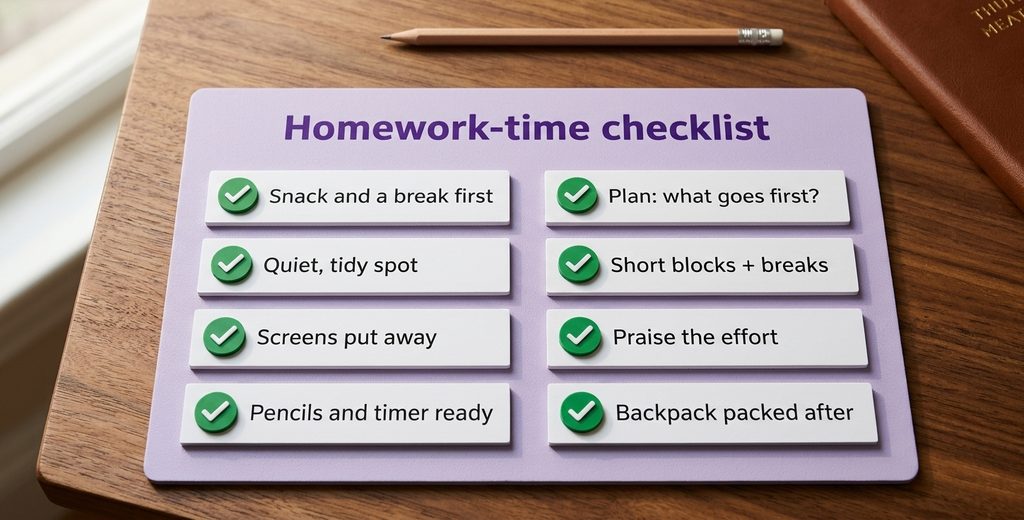
- A snack and a break before starting
- A quiet, tidy spot with good light
- Screens and phones out of reach
- Pencils, paper, and a timer ready
- A plan for what to start with
- Short work blocks with real breaks
- Praise for effort, not just results
- Homework packed in the backpack at the end
What to Avoid
Even with the best intentions, a few habits can make homework time harder:
- Threats and punishments. They may bring short-term compliance, but they teach your child to dread learning.
- Comparing siblings or classmates. It damages confidence and doesn’t motivate.
- Doing the work for them. It solves tonight but hides what your child really needs.
- Letting homework drag on for hours. If a task takes far longer than expected, stop and talk to the teacher.
- Saying “You’re lazy.” Children who avoid homework are usually overwhelmed, tired, or worried, not lazy.
When to Look Deeper
Most homework struggles pass with a bit of routine and support. But if your child is still having a very hard time after a few weeks, it’s worth looking a little deeper. Signs to watch for include:
- Frequent meltdowns or tears over homework
- Real difficulty with reading, writing, or focusing, even with help
- Stomachaches or headaches on school nights
- A sudden change in attitude toward school
- Strong worry about making mistakes
Talk with your child’s teacher first, and if the concerns continue, speak with your child’s doctor or the school’s support staff. They can help work out whether there’s something more that needs attention. Asking for help is a sign of caring, not failing.
Take Care of Yourself Too
Homework time can be stressful for parents as well. You may be tired after work, juggling dinner, and trying to stay patient while your child sighs for the fifth time. That’s completely normal.
A few reminders can help:
- You don’t need to be perfect. A calm, good-enough evening is worth more than a flawless worksheet.
- Share the load. If another adult or an older sibling can help on some days, take turns.
- Keep your expectations realistic. Some nights will go smoothly and others won’t, and that’s part of learning.
- Pause when you need to. Taking a minute to breathe gives you the energy to stay kind.
- Notice the wins. Try keeping a small “what worked” note on your phone, like a snack before homework or a five-minute dance break. After a couple of weeks you’ll see a pattern you can build on.
New routines often take a couple of weeks to feel natural, so be patient with the process and with yourself.
Make Learning More Fun Beyond Homework
Sometimes the best way to improve homework attitudes is to make learning feel good outside of homework too. Read together for fun, play word and number games, cook together, and follow your child’s interests. When children see learning as something enjoyable, schoolwork feels less like a chore.
You can browse the Free Resources section of our site for printable learning materials to use at home. If you subscribe to our newsletter, we’ll send you a free worksheet to try.
Frequently Asked Questions
Why does my child refuse to do homework?
There’s usually a reason behind it: tiredness, hunger, work that feels too hard or too boring, too many tasks at once, or worries about school. Staying curious and asking calm questions helps you find the cause.
How long should my child spend on homework each day?
This depends on your child’s age and school, so ask the teacher for guidance. For young children, short sessions of about 10 to 15 minutes at a time are often enough. If homework regularly takes much longer than the teacher expects, let the teacher know.
Should I give rewards for finishing homework?
Small, simple rewards, like extra playtime or choosing a family game, can help as a celebration. But try not to make big prizes the main motivation. The goal is to help your child feel proud of their effort.
What if my child cries over homework every night?
Stop and take a break first. Then talk calmly about what feels hard. If tears are a regular part of homework time, speak with the teacher, and consider asking for extra support if the difficulty continues.
Should I help with homework or let my child figure it out?
Be nearby and available, but let your child do the thinking. Offer hints and encouragement instead of answers. If a task is clearly too hard, tell the teacher so they can adjust it.
Should my child do homework right after school or later?
Most children focus better after a snack and a short break, so many families start 30 to 60 minutes after getting home. Watch your own child: some do well with a short session before dinner, while others need more time to unwind. What matters most is keeping the time steady.
What if my child has too much homework?
If homework regularly takes much longer than the teacher expects, or leaves your child exhausted and upset, talk to the teacher. Share what you’re noticing and ask whether the amount or the type of work can be adjusted. Teachers want to know when something isn’t working.
What if I don’t understand the homework myself?
That’s okay. Read the instructions together, look at examples in your child’s notebook, and ask your child to explain what they think it means. If you still can’t figure it out, write a short note to the teacher. It’s better to ask than to guess and teach a method that may confuse your child.
Do sticker charts and reward charts help?
For many young children, a simple chart can make progress visible and fun. Keep it small and easy, such as a sticker for each finished session. Try to focus on effort and routine rather than perfect work, and don’t take stickers away as a punishment.
Final Thoughts
A child who hates homework isn’t a lost cause. Most of the time, they’re tired, overwhelmed, or just need a different approach. Start with one or two ideas from this list, give them a couple of weeks, and keep things calm and kind.
Homework won’t always be easy, but with patience and a steady routine, evenings can feel lighter for both of you. Be gentle with your child, and with yourself too.