


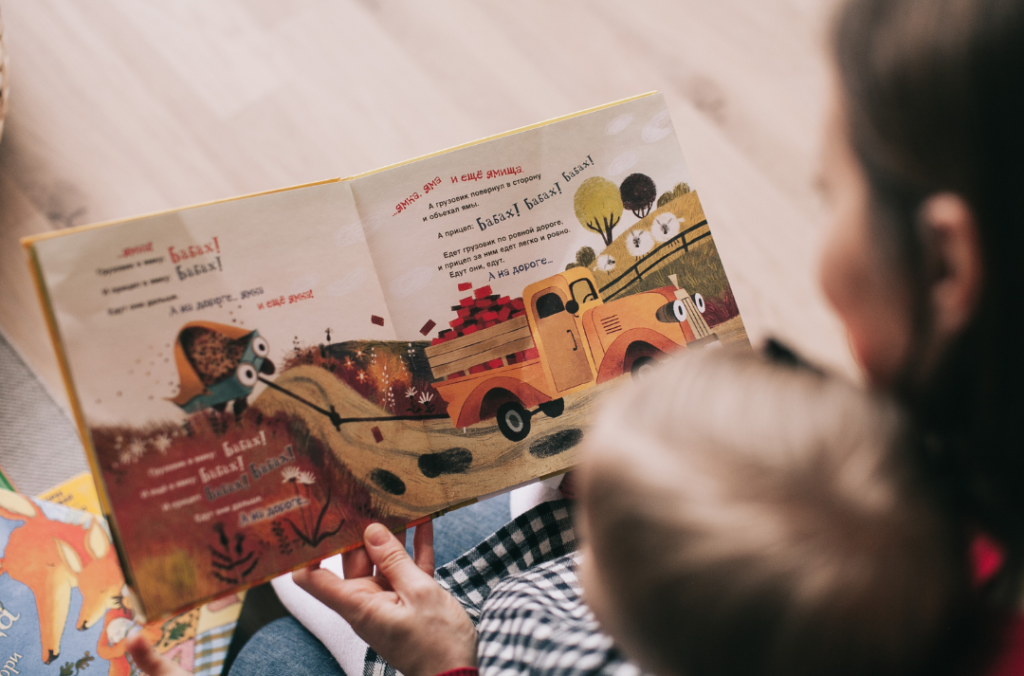
If you’ve ever sat next to your child with a picture book and wondered, “Am I doing this right?”, you’re in good company. Most parents want to help their kids learn to read, but nobody hands us a manual. School is busy, the internet is full of conflicting advice, and it’s easy to feel like you’re either doing too much or not enough.
Here’s the good news: you don’t need to be a teacher, and you don’t need fancy materials. A few minutes a day, a handful of simple habits, and a lot of patience will take you surprisingly far.
This guide walks you through how to help your child learn to read at home, step by step, in plain language. Take what works for your family and leave the rest.
Why Reading at Home Matters
School does the heavy lifting, but home is where reading becomes part of everyday life. When a child sees reading as something that happens at the kitchen table, on the couch, or before bed, it stops feeling like a task and starts feeling normal.
Home practice also gives your child something classrooms can’t always offer: one-on-one attention. You can slow down when a sound is tricky, repeat a favorite story for the tenth time, and notice exactly what makes your child light up.
And here’s the part that surprises many parents: short and regular beats long and occasional. Ten relaxed minutes every day is far more useful than an hour-long session once a week that ends in tears.
When Is a Child Ready to Start Learning to Read?
There’s no magic birthday. Children get ready at different times, and that’s completely normal. Instead of watching the calendar, watch your child. Signs that they may be ready to begin include:
- They love being read to and ask for “one more story”
- They notice letters on signs, packaging, or their own name
- They enjoy rhymes, songs, and silly word games
- They hold a book the right way up and pretend to read
- They’re curious about what words say
If you’re not seeing these yet, don’t worry. Keep reading aloud and playing with language. Those early moments are the foundation, even when it doesn’t look like “real” reading.
Step-by-Step: How to Teach Your Child to Read at Home
Step 1: Build a love of books by reading aloud every day
Before any letters or sounds, start here. Read aloud daily, even if it’s only one short book. Let your child choose the story, do the voices, and point out things in the pictures.
When reading feels cozy and fun, your child connects books with good feelings. That motivation will carry you through the harder steps later.
Step 2: Teach the alphabet and letter sounds
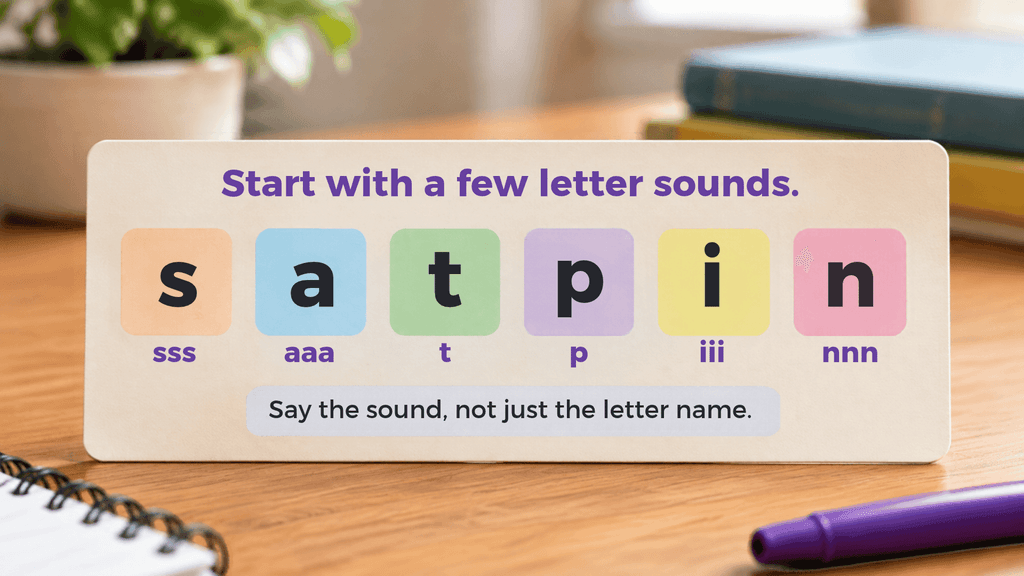
Learning letter names is useful, but the sounds are what unlock reading. A child who knows that the letter s says “sss” can start sounding out words, while knowing the name “ess” doesn’t help much on its own.
Teach a few letters at a time. Many parents start with easy, common ones like s, a, t, p, i, n because they can be combined into real words quickly. Pair each letter with a picture or an object, say the sound clearly, and let your child repeat it. Tracing letters with a finger, then with a pencil, helps the shape and sound stick together.
Step 3: Play with rhyming and the sounds inside words
This step is often skipped, but it makes a big difference. Before children can read words, they need to hear the sounds in them. This skill is called phonemic awareness, and it can be practiced with no paper at all.
Try simple games in the car or while cooking:
- “What rhymes with cat?”
- “What sound does ball start with?”
- “Can you clap the parts in banana?”
Keep it light. If it feels like a quiz, change the game.
Step 4: Blend sounds to read simple words
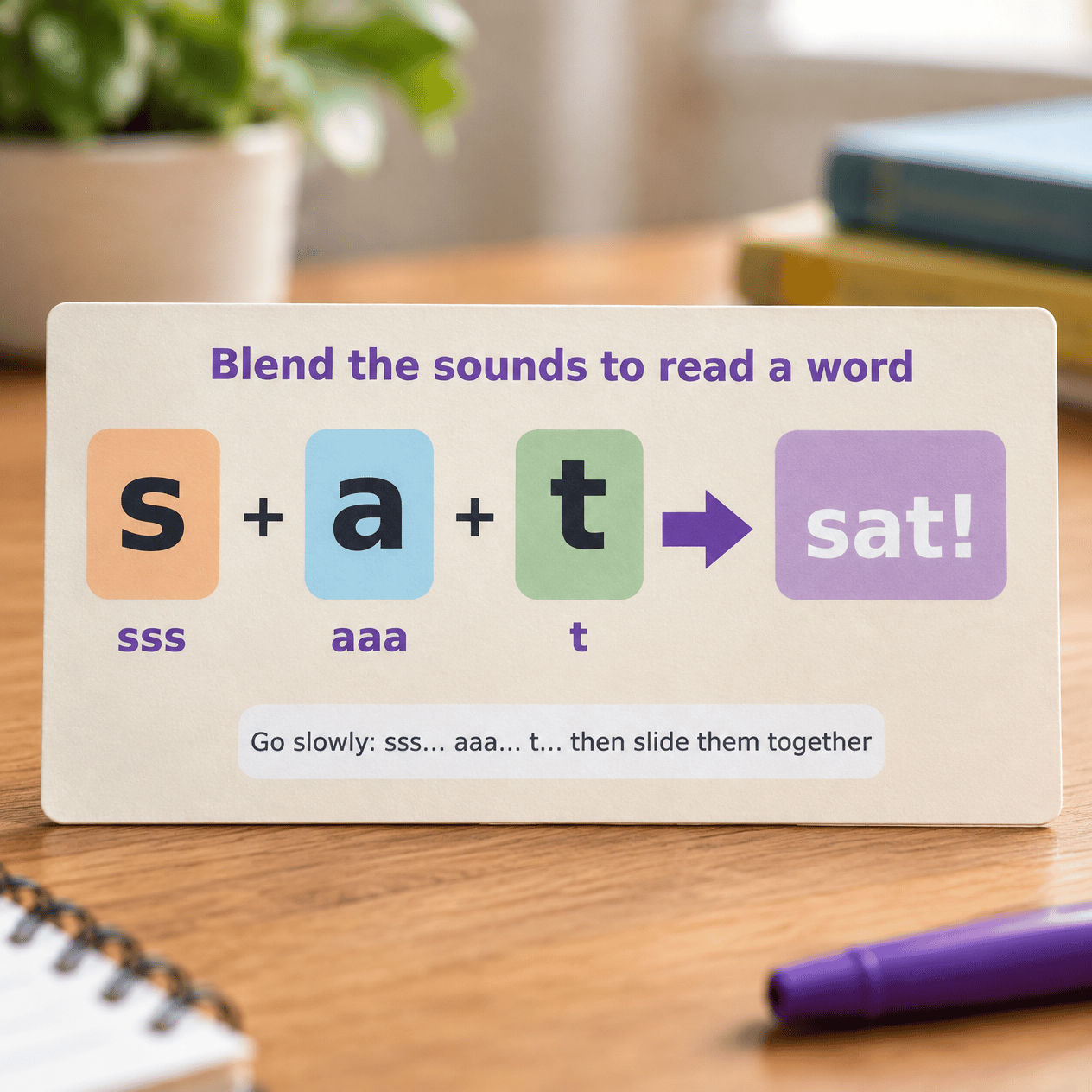
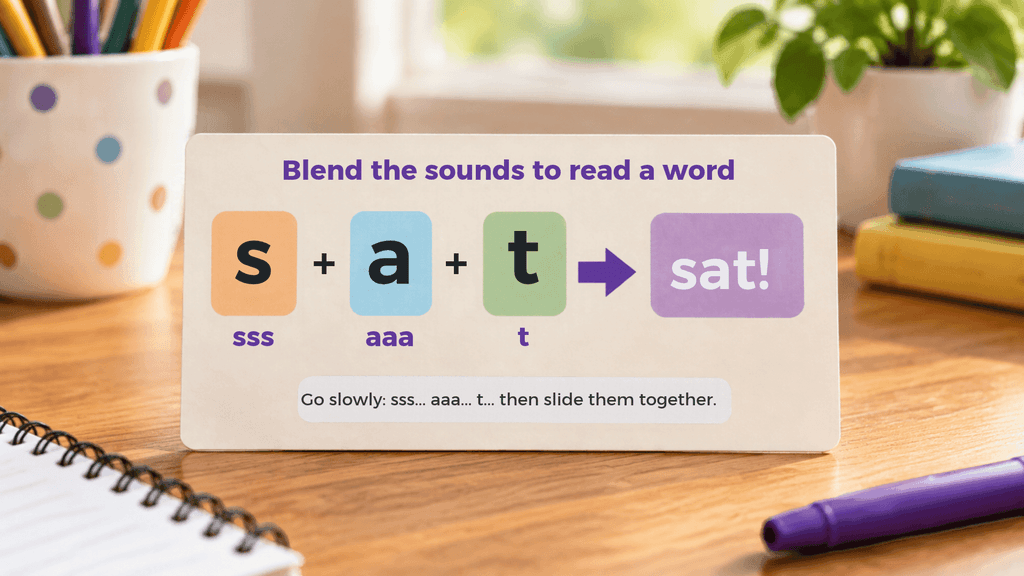
Now the fun begins. Once your child knows a few letter sounds, start blending them. Show the word sat. Say each sound slowly, “sss… aaa… t”, then slide them together: “sat!”
Start with short, three-letter words and let your child do the sounding out. Be patient with pauses. That quiet moment is the brain working, so try not to jump in too quickly with the answer.
Step 5: Introduce sight words
Not every word follows the rules. Words like the, was, said, and you appear all the time and don’t sound the way they look. These are often called sight words, and children learn them best through repeated, gentle exposure.
Introduce just two or three at a time. Write them on cards, spot them in books, and celebrate every time your child finds one. Phonics and sight words work as a team, so you don’t have to choose one or the other.
Step 6: Move on to short sentences and easy books
When your child can read simple words with confidence, it’s time to put them together. Begin with very short sentences, like “The cat sat.” Then try beginner books with large print, repeated phrases, and lots of pictures.
A good trick is to take turns: you read a page, then your child reads a page. It keeps the effort manageable and lets them hear what smooth reading sounds like.
Step 7: Let them read aloud, and praise the effort
Reading aloud builds confidence and shows you where your child needs support. When they get stuck, give them a moment, then offer a hint, such as the first sound of the word, before telling them the answer.
And when they get it right (or even get it almost right), notice the effort. “I love how you kept trying on that tricky word” goes a lot further than “good job.”
Fun Reading Activities to Try at Home
Practice doesn’t have to mean sitting still with a book. Here are a few ideas that feel more like play:
- Letter tracing and writing: Tracing connects the shape of a letter to its sound, and it’s a gentle way to start handwriting too.
- Word games: Build simple words with magnetic letters, alphabet blocks, or paper squares.
- Flashcards and scavenger hunts: Write a few words on cards and hide them around the room for your child to find and read.
- Rhyming songs and nursery rhymes: Singing is one of the easiest ways to train the ear for sounds.
- A cozy reading corner: A blanket, a few cushions, and a small basket of books is all you need. Having a special spot makes reading feel like an event.
Reading Tips by Age
Ages 2–3
At this age, it’s all about enjoyment. Read picture books together, name objects on the page, sing songs, and share rhymes. Don’t worry about teaching letters formally yet. Familiarity with books and language is the goal.
Ages 2–3
At this age, it’s all about enjoyment. Read picture books together, name objects on the page, sing songs, and share rhymes. Don’t worry about teaching letters formally yet. Familiarity with books and language is the goal.
Ages 4–5
This is a great time to explore letter names and sounds, play rhyming games, and begin blending simple words. Keep sessions short, around 10 minutes, and stop while your child is still having fun.
Ages 6–7
Many children at this stage are moving from sounding out to reading more smoothly. Encourage short chapter-style books or early readers, let them read aloud to you, and talk about what happens in the story. Asking “What do you think will happen next?” builds understanding, not just decoding.
Remember, these ranges are only a guide. Your child may be ahead in some areas and need more time in others, and that’s perfectly okay.
How to Choose the Right Books for Your Child
The best book is one your child actually wants to read. Beyond that, look for “just-right” books: ones where your child can read most of the words without much struggle, but still meets a few new ones.
A simple check: open to a page and ask your child to read it. If they stumble on nearly every word, the book is probably too hard for now (save it for reading together). If they breeze through without effort, it may be too easy, though easy books are great for building confidence.
Mix it up with:
- Picture books for enjoyment and conversation
- Rhyming books to train the ear
- Early readers with simple, repeated words for practice
Visiting your local library is a lovely, low-cost way to let your child explore and choose.
Common Mistakes to Avoid
Every parent makes a few of these, so go easy on yourself. But knowing them can save you some frustration:
- Pushing too hard or comparing. Your child isn’t in a race with their cousin, their classmate, or the neighbor’s kid. Comparison drains the joy out of learning.
- Skipping letter sounds. Guessing words from pictures can work at first, but strong sound knowledge is what carries children through longer, harder words.
- Practicing for too long. When your child is tired or frustrated, learning slows down. End on a happy note.
- Correcting every single mistake. Constant interruptions can make a child nervous about reading aloud. Let small slips go and focus on one thing at a time.
- Making reading feel like a punishment. Never use reading as a consequence. You want it to be a treat, not a chore.
How to Keep Your Child Motivated
Motivation is the secret ingredient. A motivated child will happily practice, and a discouraged one will avoid books at all costs. A few things help:
- Keep sessions playful, short, and predictable, like a bedtime story or a snack-time word game.
- Let your child choose some of the books, even if it’s the same dinosaur story for the twentieth time.
- Celebrate small wins: a new letter sound, a first full sentence, a page read without help.
- Let them see you reading. Children copy what they see, so a parent with a book is a powerful example.
If your child is struggling or seems very frustrated despite your best efforts, talk with their teacher. They can offer support and let you know if anything else needs a closer look.
Free Printable Resources to Support Your Child
Sometimes a little structure helps, especially when you’re practicing letters and early words. Printable worksheets are a simple way to add variety without spending much. Tracing pages, letter-matching sheets, and beginner word practice can all fit into a 10-minute routine.
You can browse our Free Resources section for printable learning materials to use at home, and explore our Kids section for more ideas to keep learning fun.
Frequently Asked Questions
What age should a child start learning to read?
There isn’t one right age. Many children begin to explore letters and sounds in the preschool years and start reading simple words around the time they enter school, but some start earlier and some later. Focus on readiness signs and enjoyment rather than a deadline.
How long should we practice reading each day?
For young children, about 10 to 15 minutes is plenty. Short, regular sessions work better than long ones. If your child is losing interest, it’s fine to stop and try again later.
What if my child doesn’t like reading?
Start by making it less like “work.” Let them pick the topic, whether that’s trucks, animals, or princesses, and try books, comics, and read-aloud time together. Keep the pressure low and the fun high, and give it time.
Is phonics better than memorizing words?
They work best together. Phonics gives children a tool for sounding out new words, while sight words cover the common ones that don’t follow the rules. Most children benefit from learning both.
Final Thoughts
Helping your child learn to read at home doesn’t have to be complicated. Read together every day, play with sounds, teach letters and blending a little at a time, and celebrate every bit of progress. Some days will go smoothly and others won’t, and both are part of the journey.
Most of all, remember that you’re not just teaching a skill. You’re showing your child that books are a place for curiosity, comfort, and adventure.
Ready to start? Visit our Free Resources section to find printable materials you can use today, and come back to the blog for more simple ideas to help your child learn, create, and explore.